




Grant and Susan in Zimbabwe and Botswana
August 9, 1997 - Harare, Zimbabwe
We're staying in the Holiday Inn in Harare, and have just stuffed ourselves on T-bone steak, ribs, apple pie and chocolate brownie with ice cream. And that was just my meal! Just kidding, I only had the ribs and chocolate brownie, but the food is great here, and Harare is really cosmopolitan compared with anywhere we've been yet in Africa.
We had a good long run (625 km) through from Blantyre, Malawi this morning, through Mozambique, and managed not to hit any land mines. That's a joke, they've all been cleared from that road. Although the greater risk is hitting goats or cows on the road. No problems at either border, but the Mozambicans manage to make a good profit on their transit corridor, charging us US$75 for visas, entry stamps, vehicle permit and insurance. In contrast, Zimbabwe charged us not a cent, and didn't require a visa!
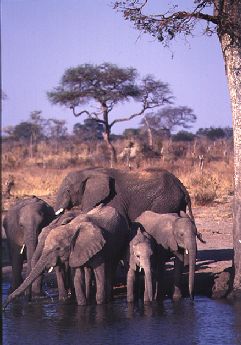
Elephants at waterhole in Hwange National Park
We went out to a shopping mall in the north- west part of Harare which just opened this year, and we could have been anywhere in North America (except the store names were not familiar to us). It was very impressive, including a 4-screen cinema, and we decided to see a movie (Con-Air), as we hadn't been to one since Cairo in June. The price is fantastic - less than US$1 each (the Zimbabwe dollar is only worth about 9 cents). So, the next day we found two more cinemas in the downtown and saw Speed 2 and Absolute Power. So, we're temporarily movied out. Traveling does make you appreciate things you take for granted when you're settled, especially in North America.
August 23, 1997 - Gwaai River, Zimbabwe - near Hwange National Park
We've been enjoying Zimbabwe, which feels very sophisticated after Malawi and Tanzania, what with roadside picnic tables and street lights, not even to mention the roads are actually maintained! Basically the white government built up an infrastructure that the blacks have maintained here. In other parts of Africa we've been, these things were not seen as being a priority, I guess. And compared with education and health care for all the people, I probably wouldn't have seen roadside picnic tables as a priority either, since so few people even own cars in this part of the world. But as a tourist traveling with a vehicle, it's very nice.
We left Harare after three days for southern Zimbabwe (if we'd stayed any longer we would have been spoiled by the luxury), and the ruins of Great Zimbabwe, the greatest medieval city (10-20,000 people) in sub-Saharan Africa. This ruin, consisting of massive (up to 15 feet wide) stone walls and enclosures dating back to the 11th century, demonstrates that ancient Africa reached a higher level of sophistication (at least in building techniques) than was evidenced by the later inhabitants who were not using stone for construction when the Europeans arrived.
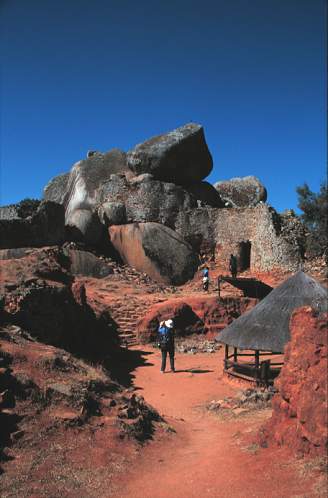
Susan at Great Zimbabwe Ruins - on the hill complex
According to Lonely Planet, up to the time of Zimbabwe's independence, the whites who ran Rhodesia were denying that Great Zimbabwe had indigenous origins and were positing Phoenician, Greek, Egyptian, Arabic or any other origins for the site. Archaeologists now are convinced there were no foreign origins, though since there was trading along the Mozambique coast from the 10th century, they have found trade goods onsite - porcelain from China, crockery from Persia and beads and trinkets from India. It's quite an interesting site, although not at all in the same class as the Roman ruins in Libya, for example. The Zimbabweans evidently didn't use stone for ordinary dwellings or temples, just enclosures, probably for defense purposes. So, there are no huge pyramids or temples there, but it's still quite a neat site, and the way they built the walls into the natural rocks is very impressive.
From Great Zimbabwe we headed northwest to what's called the Midlands, and a farm by the name of Mopani Park farm, which we had read about and sounded nice. This farm, run by white Zimbabweans, has a sideline of horse riding and bed and breakfast accommodation. We went on several horse rides, hoping to see lots of wildlife, which we had been told were not spooked by a horse the way they would be by a vehicle, even if the horse did have a rider on it. We went on a very pleasant moonlight ride in the full moon as well. We were disappointed by the quantity of wildlife, though, just a few antelope and a couple of zebra. We'd also forgotten how noisy a farm can be, with roosters that think dawn is at 3:30 a.m.! Getting there was not much fun, 60 km down a too soft dirt road, with me trying to keep very still and not gasp or squeak when we hit a soft spot and slewed sideways!
We left Mopani Park for Gweru and then Bulawayo, which is Zimbabwe's second largest city. Quite a pleasant and laid back town, but it was our bad luck to arrive there while they had a farmer's convention, so there was no accommodation in town. We ended up at a very odd motel called the Matobo Rock Motel, the first in a chain of African Rock Rondotels (possibly the last, too, as we learned it had taken them 12+ years to get it to the stage of being able to have guests). It had just opened a few months earlier, but the buildings were obviously much older than that), and there was still heaps of work to be done to finish it off. Still, it was blissfully quiet after the farm.
August 27, 1997 - Victoria Falls, Zimbabwe
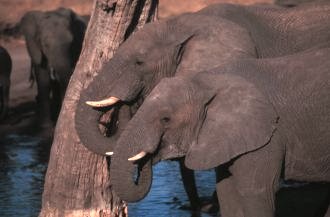
Elephant and Baby Drinking at Waterhole, Hwange National Park, Zimbabwe
Click the pic! Watch closely!
The highlight of our week was the elephants in Hwange National Park. It's a very big park in western Zimbabwe, and it reportedly has 30,000 elephants in it. The Rhodesians created all these artificial water holes using pumps to bring the water up from underground, so especially now in the dry season you can just about guarantee you'll see lots of elephants at them.
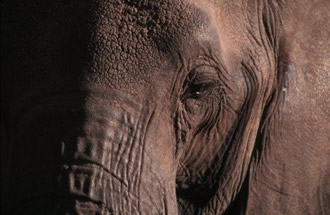
I couldn't believe how quickly the rolls of film kept going through the camera! Should have some good pics, though. We were within 20 feet of over 30 elephants, big ones, little ones, all sizes.
Victoria Falls
Victoria Falls is pretty spectacular. On the one hand, we are definitely into the most sophisticated part of Africa now, and I would agree with the Lonely Planet's assessment that Vic Falls has become " the biggest adrenaline capital-cum-tourist playground west of New Zealand". It features helicopter flights over the falls, bungy-jumping (only on the Zambian side, the Zimbabwean authorities are too sensible), white water rafting on the Zambezi, crocodile farms and multitudes of souvenir vendors.
On the other hand, there is no Madame Tussaud's, and the Zimbabwean parks authorities have managed to keep the area around the falls itself as parkland, not the manicured kind. When you're in the park you could be miles away from any town, and on a very brief walk this afternoon we saw a bushbuck (looks a lot like a deer) just a few feet from the path near the falls, so the ambiance beats Niagara Falls hands down. Unfortunately we're here during the dry season so it's considerably less spectacular than it is in June, but nonetheless very impressive.
After shipping our souvenirs home (especially the large giraffe statue we couldn't resist but certainly couldn't carry), we left Victoria Falls finally at about 2:30 in the afternoon, and crossed the border at Kazungula. The border crossing was straightforward from Zimbabwe, the immigration official stamped our passports and some other bits of paper, and said we could go. I headed out, and we got dressed up and rolled up to the gate, where the gate attendant asked for the gate pass.
"What gate pass?"
"The gate pass you were given in the office."
I checked my pockets, trying to remember if I had been given anything, looked in the passports, couldn't find any little pieces of paper anywhere. I lost it then, probably because I was hot and sweaty, and nobody had said boo about gate passes or given me anything that I could remember. Thoroughly pissed off, I told Susan to get off, and told the guard that I was pissed off.
"Nobody gave me anything or said anything about a gate pass, and they bloody well should have!"
I ripped my gloves, helmet and jacket off, slamming them down in a fit of pique, and stomped back to the office, and got another gate pass. I did manage to be a little cool doing that. Not ordinarily a good thing to get pissed off with border guards, and I certainly would never have done it with an Arab border guard. These guys were so mellow and laid back they really didn't care, and that was probably part of the problem.
Later I found the gate pass in my wallet - I had obviously put it away thinking it was a receipt and promptly forgotten about it. Yes they should have said I needed it to get out the gate, but with the number of borders I've crossed, I should know better, and have kept everything handy in my shirt pocket until out of sight. And kept my cool too. Sorry guys.
The entry into Botswana was easy, until they asked about insurance for the bike...
I dutifully pulled out the yellow card insurance we got in Kenya, that was supposed to be good in Botswana as well.
"Oh, we get a lot of people with this, but we don't recognize it."
"But it says here it's good in Botswana."
"We don't recognize it."
"Sooo...?"
"You will have to buy insurance."
Sigh. "How much?"
"It is 15 pula."
"I don't have any pula, can I use Zim$?"
"No."
"Can I change my Zim$ here anywhere?"
"No."
"So, now what?" Hoping I could get out of buying insurance that was probably worthless anyway.
"You must buy insurance. You can use US$ traveller's cheques."
"Oh." Darn. "How much in US$?"
"$5.00."
"Can you change US$100.00 traveller's cheque?"
"Oooh, nooo, don't you have a smaller traveller's cheque?"
"No, how about US cash?"
"Oooh, nooo, we can't accept cash, only traveller's cheques."
I looked at him, and he looked at me. Impasse.
He tossed me back my papers, and said, "Pay it at the other border when you leave," and waved me away.
Yes! Success! For once. I left as quickly as possible before he changed his mind.
We ended up at Chobe Safari Lodge in Kasane, Botswana, for the night.
August 29, 1997 - Kasane
We left at about 9:00 from Kasane for the border crossing at Ngoma bridge to Namibia. The road to the park was excellent, but as we entered the park, the road was under repair, in this case meaning that they were spreading gravel on the road for retarring later, and doing some work on the drainage systems. This was an unnoticed - or at least unheeded - harbinger of things to come. The gravel spreading was interesting. There were about 20 women along the road, with straw brooms, slowly sweeping the gravel that had been pushed aside back into the wheel tracks. A little farther down the road, we passed a sweep machine crewed by two men, leaving a great cloud of dust behind, but when I looked, doing absolutely nothing discernible to the gravel - the women with their straw brooms were doing a much more effective job.
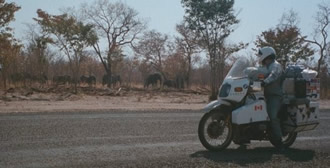
Grant and elephants on the main road through Chobe N.P., Botswana
The highlight of the day was that we actually saw elephants along the road in the park, nothing between us and them. Susan immediately jumped off to get a picture of me and the motorcycle with elephants in the background, I stayed on the bike in case we had to make a quick getaway. After that things went downhill rapidly.
A couple of kilometers from the border, there was a detour into the bushes. More serious road work. The track was good hard dirt, no problem. Another unheeded warning. The border crossing from Botswana was a doddle, stamp stamp you're out of here.
The first serious warning about the road ahead was the Ngoma bridge itself over a river, not much to look at this time of the year, but clearly a big river in the rainy season. The bridge was a single lane track, covered with sand and fine gravel - our worst enemy. It wasn't as bad as it looked, but gave me a few anxious moments, as I envisioned getting bogged down and falling over, with us rolling tidily over the bridge into the river. There were of course no guard rails, just flush road. We made it all right, only a couple of anxious moments as the wheels bogged in the sand and the front wheel twitched sideways, but I wasn't happy about it. Hopefully the road condition was just because this was between the two borders and therefore nobody wanted responsibility. How wrong I was! Thus began the saga of the Caprivi Strip...

Global Rescue is the premier provider of medical, security and evacuation services worldwide and is the only company that will come to you, wherever you are, and evacuate you to your home hospital of choice.
Additionally, Global Rescue places no restrictions on country of citizenship - all nationalities are eligible to sign-up! Travel medical insurance is also available, currently the limit is 90 days. (TIP: For Evac insurance - Click Multiple Trips and 365 days to get year long insurance.)

Ripcord Rescue Travel Insurance™ combines into a single integrated program the best evacuation and rescue with the premier travel insurance coverages designed for adventurers.
Led by special operations veterans, Stanford Medicine affiliated physicians, paramedics and other travel experts, Ripcord is perfect for adventure seekers, climbers, skiers, sports enthusiasts, hunters, international travelers, humanitarian efforts, expeditions and more.
Ripcord travel protection is now available for ALL nationalities, and travel is covered on motorcycles of all sizes! NOTE: Travel medical insurance currently has a limit of 90 days.
Member login
Announcements
Thinking about traveling? Not sure about the whole thing? Watch the HU Achievable Dream Video Trailers and then get ALL the information you need to get inspired and learn how to travel anywhere in the world!
Have YOU ever wondered who has ridden around the world? We did too - and now here's the list of Circumnavigators!
Check it out now, and add your information if we didn't find you.
Are you an Overland Adventure Traveller?
Does the smell of spices wafting through the air make you think of Zanzibar, a cacophony of honking horns is Cairo, or a swirl of brilliantly patterned clothing Guatemala? Then this is the site for you!
Hosted by Grant and Susan Johnson, RTW 1987-1998
Johnson's Home
Who Are We?
The BIKE Story
Press Stories about us
Our "Rules of the Road"
Photo Album 500+ images
"Quick" highlights -
Top 31 photos
Mexico
Central America
New Zealand
Australia
Europe
England
Isle
of Man
Norway
Sweden
Denmark
Germany
Netherlands
Spain
Gibraltar
Africa
Tunisia
Libya
Egypt
Kenya
Tanzania
Malawi
Zimbabwe
Botswana
Namibia
Caprivi Strip
Etosha
Sossusvlei
South
Africa
South America
Argentina
Tierra del Fuego
Chile
Peru
Ecuador
Colombia
Next HU Events

HU Event and other updates on the HUBB Forum "Traveller's Advisories" thread.
ALL Dates subject to change.
2024:
- California: April 18-21
- Virginia: April 25-28
- Germany Summer: May 9-12
- Québec: May 17-19
- Bulgaria Mini: July 5-7
- CanWest: July 11-14
- Switzerland: August 15-18
- Romania: August 30-Sept 1
- Ecuador: August 24-25
- Austria: September 12-15
- France: September 20-22
- Queensland is back! Date TBC
- Germany Autumn: Oct 31-Nov.3
- South Africa: November
Add yourself to the Updates List for each event!
Questions about an event? Ask here
HU Achievable Dream is Online
and available now to stream on Vimeo!
ALL 15 chapters of the HU Achievable Dream Guide are available to download on Vimeo!
Binge watch over 18 hours of inspiring, informative and entertaining stories and tips from 150 travellers!
"a cross between entertaining stories, tech tips, and reference guide"
"A timeless introduction to Motorcycle Adventure Travel!"
Originally launched as a 7 DVD set, The Achievable Dream series can now be downloaded anywhere. OVER 18 hours of solid info take up zero space in your panniers. How convenient!
Books

All the best travel books and videos listed and often reviewed on HU's famous Books page. Check it out and get great travel books from all over the world.
NOTE: As an Amazon Affiliate we earn from qualifying purchases - thanks for your help supporting HU when you start from an HU Amazon link!