






Air/Fuel Mixture at Altitude for Bing carburetors, as fitted to BMW
From the Bing
Agency (the best place to get Bing parts in North America) Manual:
"From sea-level to about 3,000 feet / 914 meters elevation, atmospheric pressure decreases about one-inch-per-thousand feet / 0.1 bars per 1000 meters of altitude-therefore our 29.92 inches of Mercury / 1.013 bars barometer reading at sea-level now becomes about 27 inches of Mercury / 0.914 bars. At 5,000 feet / 1500 meters, about 25 inches of Mercury / 0.84 bars , and 20.6 inches of Mercury / 0.69 bars at 10,000 feet / 3000 meters.
Our engine (and carburetor) only react to air velocity-not weight of air. Not knowing this, the carburetor continues flowing the same amount (by weight) of fuel, and all of a sudden our "ideal mixture" at sea-level becomes extremely rich at higher elevations.
The Bing carburetor is less susceptible to changes in elevation than other carburettors in use, and in general does not require jetting changes for the idle and lower part-throttle settings. These settings can be compensated for by mixture screw adjustment. However, the upper part-throttle range will require the lowering of the jet needle to lean out mixture and continuous operation at higher elevation certainly necessitates the changing of the main jet. The table provides all information necessary to determine jetting changes in relation to altitude changes..
| Altitude in feet: | 0 | 1,600 | 3,300 | 5,000 | 6,500 | 8,200 | 10,000 | 11,500 | 13,000 | |
| Altitude in meters: | 0 | 500 | 1000 | 1500 | 2000 | 2500 | 3000 | 3500 | 4000 | |
| Temp (F) | Temp (Celsius) | A2 or A1: | ||||||||
| -22 F | -30 C | 104 | 103 | 101 | 100 | 98 | 97 | 95 | 94 | 93 |
| - 4 F | -20 C | 103 | 102 | 100 | 99 | 97 | 96 | 95 | 93 | 92 |
| +14 F | -10 C | 102 | 101 | 99 | 98 | 96 | 95 | 94 | 92 | 91 |
| +32 | 0 | 101 | 100 | 98 | 97 | 95 | 94 | 93 | 91 | 90 |
| +50 | +10 | 100 | 99 | 97 | 96 | 95 | 93 | 92 | 91 | 89 |
| +59 | +15 | 100 | 99 | 97 | 96 | 94 | 93 | 92 | 90 | 89 |
| +68 | +20 | 100 | 98 | 97 | 95 | 94 | 93 | 91 | 90 | 88 |
| +86 | +30 | 99 | 97 | 96 | 94 | 93 | 92 | 90 | 89 | 88 |
| +104 | +40 | 98 | 96 | 95 | 94 | 92 | 91 | 90 | 88 | 87 |
| +122 | +50 | 97 | 96 | 94 | 93 | 92 | 90 | 89 | 88 | 86 |
EXAMPLE: You're going to do a lot of touring in Colorado (Elevation about 5,000 feet / 1500 meters). Your machine is performing just fine in Galveston, Texas (Elevation 7 feet / 2 meters). Your main jet is size 150. Temperature in Galveston (86 degrees F / 30 degrees C)-Denver (50 degrees F/ 10 degrees C). The new jet required to obtain the same mixture ratio as was provided by the size 150 is determined from the equation:
J2= A2/A1 X J1
Where:
A2 = the second altitude (Colorado)
A1 = the first altitude (Galveston)
J1 = original main jet (150)
A2 = 96 (alt 5,000-temp. 50 deg.)
A1 - 99 (alt "0"-temp 86 deg.)
J1 - 150 (original main jet)
J2 =96/99 x 150 or, .97 x 150 = 145
Therefore, the same mixture at sea-level with a 150 main jet will be achieved at 5,000 feet / 1500 meters with a 145 main jet (AT ABOVE TEMPERATURES ONLY)
If temperature in Colorado was 86 degrees, we would have:
J2 = 94/99 x 150 = .95 x 150 = 142
When changing jets for altitude, always make correction for temperature as well."
Effect of Altitude on Horsepower,
by Tom Vervaeke
(Doing some research) ..."on the effects of elevation on available horsepower. I did a quick web search and found the following HP calculator.
I did a few runs using the factors below. I only changed the altitude after each calculation.
Constants I used:
----------------
Air Temp: 80 F / 27 C (median for us in summer)
Barometric Pressure: 29.96 / 1,013 bar (standard)
Dew Point: 50 F / 10 C (about normal for Colorado)
| Elevation in Feet: |
Meters: | Relative HP |
| 0 | 0 | 101.2% |
| 500 | 152 | 99.0% |
| 1000 | 305 | 96.9% |
| 2000 | 610 | 92.8% |
| 3000 | 914 | 88.8% |
| 4000 | 1219 | 85.1% |
| 5000 | 1524 | 81.4% |
| 6000 | 1829 | 78.0% |
| 7000 | 2134 | 74.6% |
| 8000 | 2438 | 71.4% |
| 9000 | 2743 | 68.4% |
| 10000 | 3048 | 65.4% |
| 11000 | 3353 | 62.6% |
| 12000 | 3658 | 59.9% |
| 13000 | 3962 | 57.2% |
| 14000 | 4267 | 54.7% |
So, on average, around town in Denver I've got about 81.4% of the HP someone at sea level would have. On top of Mt. Evans (14,000 feet / 4267 meters) you only have about 54.7% of the available HP. Typical mountain riding in the 8000-10,000 feet / 2400 – 3050 meters range shows us with a 30-35% loss. About what I'd guess. I have no idea on how accurate this calculator is but at a first glance it seems about right.
Tom Vervaeke, Colorado, USA"
Editors note - I think this is roughly valid, ASSUMING that the jetting is corrected for each altitude as well. If you don't change anything and go from properly jetted at sea level straight to 14,000 feet / 4267 meters, the loss will be even greater. EFI bikes should be pretty close to this as the injection system should compensate.
The R1100GS for instance works quite well at altitude without any changes. My R80G/S at 10,000 feet / 3048 meters without jetting changes is truly pathetic. Don't make the mistake one traveller made, and set the jetting for altitude then drop to sea level, as you can easily do in Peru in a few hours, and not change the jets - you'll melt the engine.
Metric conversion thanks to Daan Stehouwer, the Netherlands
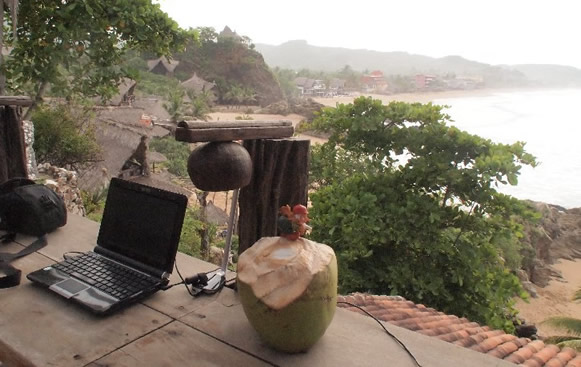
A tough place to get any work done, but the conversion got done!
by Daan Stehouwer, on his and Mirjam's RTW

Global Rescue is the premier provider of medical, security and evacuation services worldwide and is the only company that will come to you, wherever you are, and evacuate you to your home hospital of choice.
Additionally, Global Rescue places no restrictions on country of citizenship - all nationalities are eligible to sign-up! Travel medical insurance is also available, currently the limit is 90 days. (TIP: For Evac insurance - Click Multiple Trips and 365 days to get year long insurance.)

Ripcord Rescue Travel Insurance™ combines into a single integrated program the best evacuation and rescue with the premier travel insurance coverages designed for adventurers.
Led by special operations veterans, Stanford Medicine affiliated physicians, paramedics and other travel experts, Ripcord is perfect for adventure seekers, climbers, skiers, sports enthusiasts, hunters, international travelers, humanitarian efforts, expeditions and more.
Ripcord travel protection is now available for ALL nationalities, and travel is covered on motorcycles of all sizes! NOTE: Travel medical insurance currently has a limit of 90 days.
Member login
Announcements
Thinking about traveling? Not sure about the whole thing? Watch the HU Achievable Dream Video Trailers and then get ALL the information you need to get inspired and learn how to travel anywhere in the world!
Have YOU ever wondered who has ridden around the world? We did too - and now here's the list of Circumnavigators!
Check it out now, and add your information if we didn't find you.
Are you an Overland Adventure Traveller?
Does the smell of spices wafting through the air make you think of Zanzibar, a cacophony of honking horns is Cairo, or a swirl of brilliantly patterned clothing Guatemala? Then this is the site for you!
Hosted by Grant and Susan Johnson, RTW 1987-1998
Next HU Events

HU Event and other updates on the HUBB Forum "Traveller's Advisories" thread.
ALL Dates subject to change.
2024:
- California: April 18-21
- Virginia: April 25-28
- Germany Summer: May 9-12
- Québec: May 17-19
- Bulgaria Mini: July 5-7
- CanWest: July 11-14
- Switzerland: August 15-18
- Romania: August 30-Sept 1
- Ecuador: August 24-25
- Austria: September 12-15
- France: September 20-22
- Queensland is back! Oct 4-7
- Germany Autumn: Oct 31-Nov.3
- South Africa: November
Add yourself to the Updates List for each event!
Questions about an event? Ask here
HU Achievable Dream is Online
and available now to stream on Vimeo!
ALL 15 chapters of the HU Achievable Dream Guide are available to download on Vimeo!

Binge watch over 18 hours of inspiring, informative and entertaining stories and tips from 150 travellers!
"a cross between entertaining stories, tech tips, and reference guide"
"A timeless introduction to Motorcycle Adventure Travel!"
Originally launched as a 7 DVD set, The Achievable Dream series can now be downloaded anywhere. OVER 18 hours of solid info take up zero space in your panniers. How convenient!
Books

All the best travel books and videos listed and often reviewed on HU's famous Books page. Check it out and get great travel books from all over the world.
NOTE: As an Amazon Affiliate we earn from qualifying purchases - thanks for your help supporting HU when you start from an HU Amazon link!