




Grant and Susan in Namibia
August 31, 1997 - Rundu, Namibia
We rested up at Popa Falls, then rode 200 km. to Rundu today, a small town on the northern border of Namibia. Angola is just across the river from us. The grocery stores and prices and amenities here are quite a shock. We have a nice place, TV and direct dial phone, air conditioning, lovely view of the Okavango River, and a kitchen, for only about US$45.00. After Victoria Falls, this is incredibly CHEAP! The stores are full of good stuff, so since we had a kitchen I went a little crazy, and now have supplies enough to cook for several days. We were getting very tired of boring unhealthy fatty hotel food anyway.
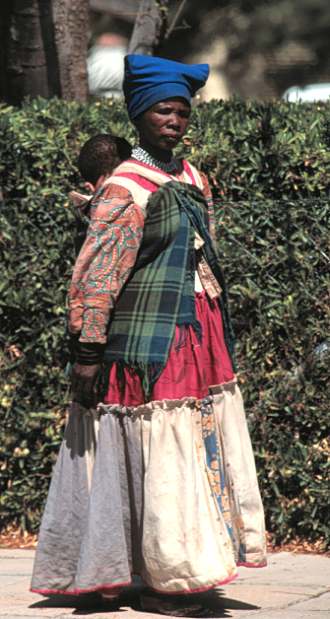
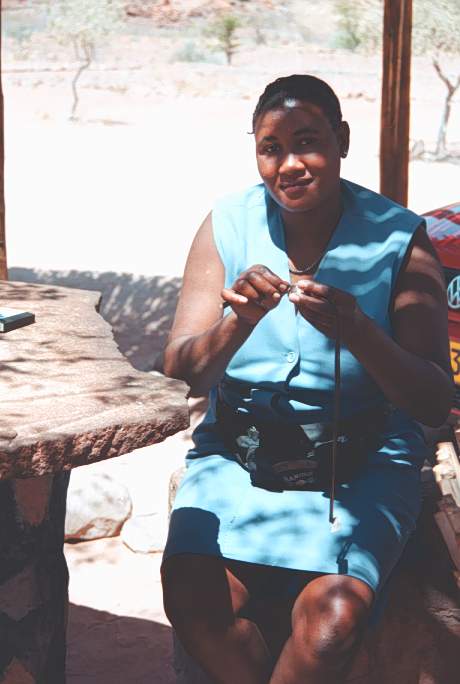
Herero woman in "traditional" dress
September 10, 1997 - Tsumeb, Namibia
As with everywhere else in Africa, we couldn't enter the game parks here in Namibia with the bike, and we really were keen to do Etosha National Park. So, we rented a 4 WD truck and parked the bike at our hotel in Tsumeb for a week. With the truck, we were able to tour the park on our own, camping in the campsites run by the Ministry of Environment and Tourism here.
Etosha National Park - separate page.
Go to Etosha National Park, then select Back on your browser, you should come back to here.
We spent 4 wonderful days in Etosha, then headed further west off the paved roads to sandy/dirt roads that we knew would be difficult or impossible to do on the bike. Namibia has some very interesting geography, resembling western North America, and Grant took lots of photos of unusual rock formations and plants.
We were up at dawn for pictures at Burnt Mountain, then on to rock carvings at Twyfelfontein. Grant went on a guided tour, I watched "Queen Elizabeth" carving makalani nuts (also known as vegetable ivory), into animal shapes, and bought a number for presents. On to Palmwag through interesting, sometimes spectacular scenery.
Lest it be thought we only saw wild animals and scenics in the north, I should mention the Herero women in the small towns. These women adopted the style of dress of German missionary women's maids of the last century, and have continued to wear this as their "traditional" dress ever since. Totally impractical for the climate, the dresses include multiple layers of petticoats. They certainly do stand out on the street, though!
September 14, 1997- Windhoek, Namibia
We're about half way down Namibia now, in the capital, Windhoek, which is pretty impressive in its ordinariness. This place could be anywhere in North America or Europe and wouldn't rate mentioning, but the fact that it's in southern Africa makes it exceptional.

After returning the truck in Tsumeb and repacking the bike, we headed south to Okonjima guest ranch. This place was worth the 24 km on dirt roads to get to it. Okonjima is the home of the Africat Foundation, and they use the revenue from guest accommodation to fund its activities. They serve as a home for orphaned cats.
Cheetahs wander on the lawns, and caracals, which are smallish wildcats (about the size of a medium-sized dog) with very long pointy ears, walk right into your room just like a house cat. They also have playful lions, and leopards coming to a hide to eat.
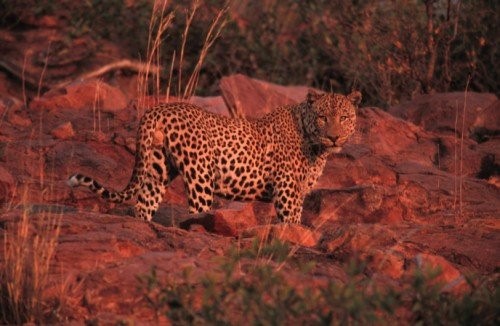
Wonderful place, unfortunately we could only stay one night as they were fully booked, so we reluctantly left the next morning for Windhoek.
Namib Park
We left Swakopmund on 28 September to do the Welwitschia Drive in the northern Namib park. The main feature of this drive is the Welwitschia plant, which is a plant unique to Namibia that thrives on the limited moisture it receives from the mist which rolls into the desert from the ocean. The oldest specimens are 2,000 years old, which earns the plant the nickname of being a living fossil. It lives almost 30 years underground before it pokes its head above the ground, and its only two leaves get torn into shreds by wind so that it looks quite scruffy. Not as riveting as zebra or leopards, but I have to work on my bias towards mammals vs. plants. The rest of Welwitschia drive (which has its own brochure and map, and is even mentioned in the Lonely Planet) includes desert lichen, a desolate moonscape and underground rivers which support trees in the desert. Grant took way more pictures than I did, often times I'd stay in the air-conditioned truck while he hopped out to take a pic.
Despite being written up in the Lonely Planet, there were not hordes of tourists in this area, and we camped all by ourselves out in the desert that night, under the stars. The truck was set up for self-sufficient camping, with a full mattress on a platform in the back, so we were quite comfortable.
Sossusvlei, Namib National Park - separate page.
Go to Sossusvlei, then select Back on your browser, you should come back to here.
October 5, 1997 - Windhoek
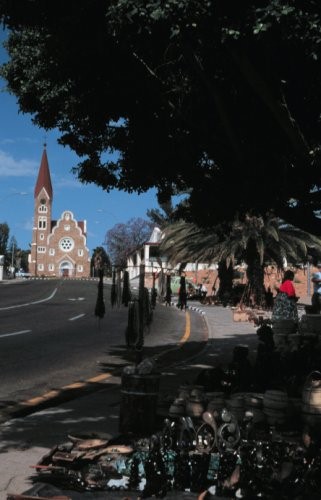
Church, Windhoek, Namibia
We're back in Windhoek after a week in the Namib Desert. It is marginally cooler here in Windhoek (1400 meters) than it was in the desert, but still we have been experiencing over 40C every day for the past week.
We are staying with Norbert and Mona Irlich, the folks at Pegasus we rented the truck from, they have rooms available for their customers, and Grant spent much of Saturday and today working on the bike, as they have quite a good workshop (they own 21 rental trucks). Unfortunately, Windhoek is also experiencing a heat wave, so keeping cool is difficult. Tuesday we plan to hit the road again, this time on our normal mode of transport, but travel in the mornings only if this heat continues.
October 10, 1997 - Luderitz, Namibia
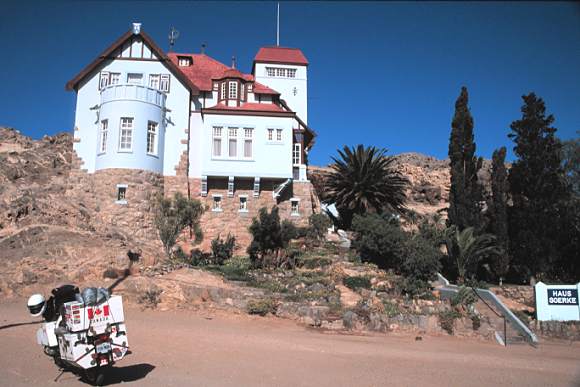
Goerke Haus, Luderitz
We got delayed in Windhoek by our battery giving up the ghost. It was dead when we got back from the desert, and Grant charged it up, then it was dead again the next day. So, we replaced it, grateful that it chose the first place south of Europe where there was actually a BMW motorcycle shop, (which actually had our battery in stock), to give up its life. Anywhere else would have been a major nuisance and put us out of commission until we had one sent in.
After all the heat in Windhoek, we decided to get an early start and were actually on the road by sunrise Wednesday. That was the morning it cooled off, and we had to stop and put on the electric vests after an hour because we were freezing! Had a good 500 km run to Keetmanshoop, and Grant was still feeling energetic enough to head to the coast. So we headed off and made another 200 km by 4 p.m.
We got as far as Aus, (a one horse town where the horse died), where we stopped for a coke and found out that the road to Luderitz had sand blown over it and was not recommended to proceed. The purveyor of this information just happened to have a room available for the night, so we decided to stay over. Thursday morning we slept in a little, got on the road by 10:00 with our electric vests on, stopped to take photos of some wild horses near Aus, then the landscape changed and we were in desert again, and it was getting hot! Vests off, all vents open. It got hotter and more desolate towards Luderitz, then about 30 km out of Luderitz, the wind shifted around, coming off the ocean (head wind) and the temperature dropped about 10 degrees C immediately. Vests back on high, vents closed again. Sigh.
Signs along the road warned of WIND and SAND, and sure enough, there were drifts across the paved road, and plenty of wind. Nothing we couldn't get through, though, as the plows had been through the worst areas. You could see in a couple of spots that the drifts had been about a metre deep on the road! Apparently they have to plow the road almost continuously in this area otherwise it gets impassable.
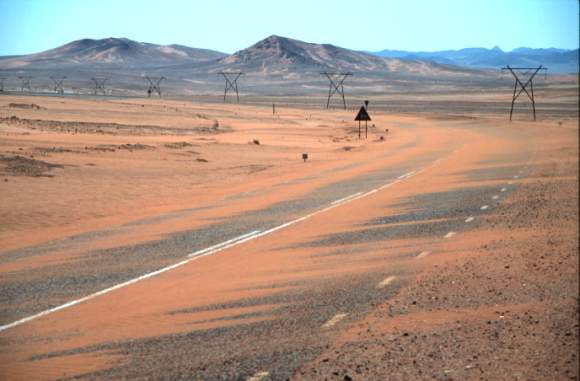
Sand blowing on the road to Luderitz, Namibia
The main attraction in the area is Kolmanskop, a ghost town in the desert outside Luderitz. The only reason people ever lived there was that diamonds were discovered in this area. At one time (in the 1920's) Kolmanskop was the richest town in the world, according to the tour guide. The diamond mines operated until the late 50s, then shut down, and the town followed. The dunes have been taking over relentlessly ever since.
I can certainly vouch for the fact that no one would live there except for economic reasons. Arid, windswept, desolate, all those adjectives came to mind as we drove through to Luderitz. We timed our visit right, the wind had been blowing in from the desert for three days and the swimming pool at the hotel was full of sand! It had just stopped blowing the morning we drove in.
So, we've now done as much of Namibia as we're going to. We will definitely come back at some point if we can, but next time we'll fly into Windhoek and rent a 4x4. Namibia has some wonderful scenery, but you can't get to most of it by public transport, and you can't get to all of it with a motorcycle or even a regular car.

Global Rescue is the premier provider of medical, security and evacuation services worldwide and is the only company that will come to you, wherever you are, and evacuate you to your home hospital of choice.
Additionally, Global Rescue places no restrictions on country of citizenship - all nationalities are eligible to sign-up! Travel medical insurance is also available, currently the limit is 90 days. (TIP: For Evac insurance - Click Multiple Trips and 365 days to get year long insurance.)

Ripcord Rescue Travel Insurance™ combines into a single integrated program the best evacuation and rescue with the premier travel insurance coverages designed for adventurers.
Led by special operations veterans, Stanford Medicine affiliated physicians, paramedics and other travel experts, Ripcord is perfect for adventure seekers, climbers, skiers, sports enthusiasts, hunters, international travelers, humanitarian efforts, expeditions and more.
Ripcord travel protection is now available for ALL nationalities, and travel is covered on motorcycles of all sizes! NOTE: Travel medical insurance currently has a limit of 90 days.
Member login
Announcements
Thinking about traveling? Not sure about the whole thing? Watch the HU Achievable Dream Video Trailers and then get ALL the information you need to get inspired and learn how to travel anywhere in the world!
Have YOU ever wondered who has ridden around the world? We did too - and now here's the list of Circumnavigators!
Check it out now, and add your information if we didn't find you.
Are you an Overland Adventure Traveller?
Does the smell of spices wafting through the air make you think of Zanzibar, a cacophony of honking horns is Cairo, or a swirl of brilliantly patterned clothing Guatemala? Then this is the site for you!
Hosted by Grant and Susan Johnson, RTW 1987-1998
Johnson's Home
Who Are We?
The BIKE Story
Press Stories about us
Our "Rules of the Road"
Photo Album 500+ images
"Quick" highlights -
Top 31 photos
Mexico
Central America
New Zealand
Australia
Europe
England
Isle
of Man
Norway
Sweden
Denmark
Germany
Netherlands
Spain
Gibraltar
Africa
Tunisia
Libya
Egypt
Kenya
Tanzania
Malawi
Zimbabwe
Botswana
Namibia
Caprivi Strip
Etosha
Sossusvlei
South
Africa
South America
Argentina
Tierra del Fuego
Chile
Peru
Ecuador
Colombia
Next HU Events

HU Event and other updates on the HUBB Forum "Traveller's Advisories" thread.
ALL Dates subject to change.
2024:
- California: April 18-21
- Virginia: April 25-28
- Germany Summer: May 9-12
- Québec: May 17-19
- Bulgaria Mini: July 5-7
- CanWest: July 11-14
- Switzerland: August 15-18
- Romania: August 30-Sept 1
- Ecuador: August 24-25
- Austria: September 12-15
- France: September 20-22
- Queensland is back! Date TBC
- Germany Autumn: Oct 31-Nov.3
- South Africa: November
Add yourself to the Updates List for each event!
Questions about an event? Ask here
HU Achievable Dream is Online
and available now to stream on Vimeo!
ALL 15 chapters of the HU Achievable Dream Guide are available to download on Vimeo!

Binge watch over 18 hours of inspiring, informative and entertaining stories and tips from 150 travellers!
"a cross between entertaining stories, tech tips, and reference guide"
"A timeless introduction to Motorcycle Adventure Travel!"
Originally launched as a 7 DVD set, The Achievable Dream series can now be downloaded anywhere. OVER 18 hours of solid info take up zero space in your panniers. How convenient!
Books

All the best travel books and videos listed and often reviewed on HU's famous Books page. Check it out and get great travel books from all over the world.
NOTE: As an Amazon Affiliate we earn from qualifying purchases - thanks for your help supporting HU when you start from an HU Amazon link!