 2Likes 2Likes
-
 1
Post By PanEuropean
1
Post By PanEuropean
-
1
Post By PanEuropean
 |

16 Jun 2006
|
|
Gold Member
Veteran HUBBer
|
|
Join Date: Jan 2002
Location: Toronto, Canada
Posts: 2,125
|
|
|
2006 Rules for shipping motorcycles by air freight
I originally posted this as a response to another conversation in the North American forum, but thought the information might be of use to people who are reading this forum.
-------------------------------
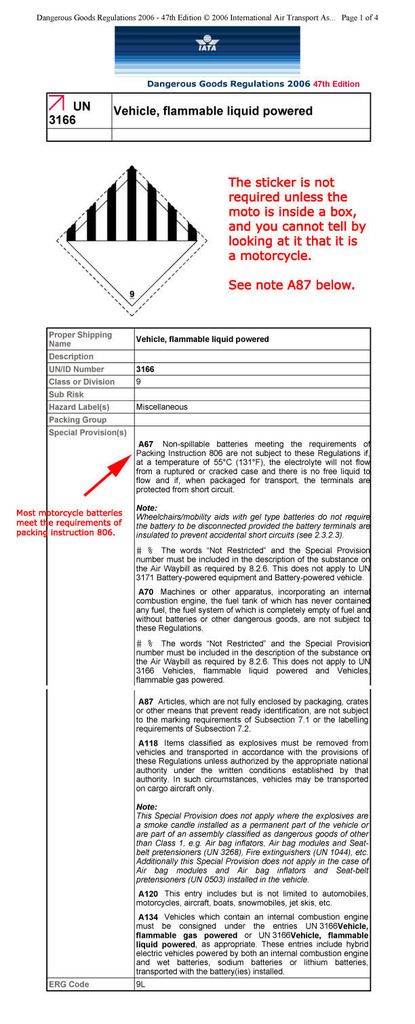
Below you will find the complete text of the IATA Dangerous Goods Regulations (DGR) that govern shipping motorcycles by air.
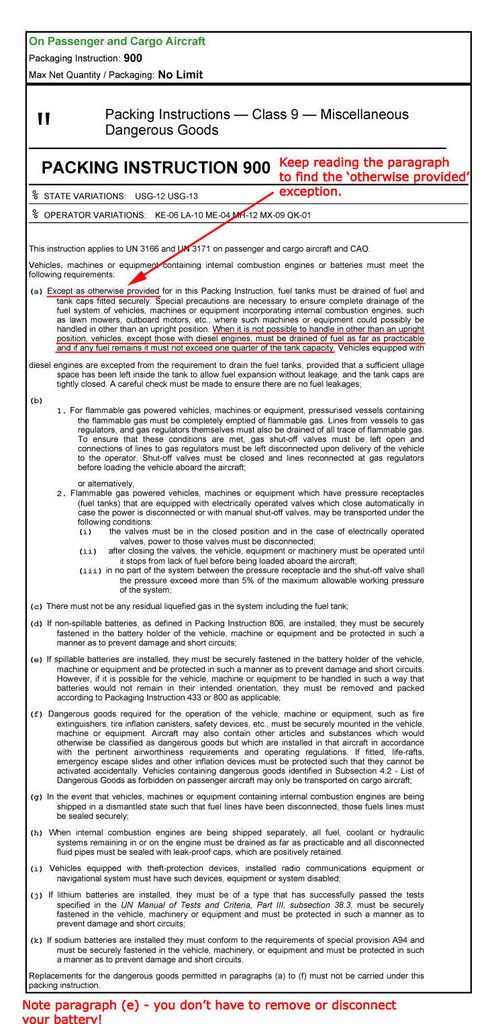
The moto itself is classified under UN 3166 as a 'Vehicle, Flammable Liquid Powered'. The Packing Instruction that gives the details of how the vehicle must be packed so that it is accepted for shipment is Packing Instruction 900.
The first image below shows the rules for UN 3166, the second illustration shows the rules for Packing Instruction 900. The two go hand in hand, in other words, if you comply with the packing instruction, you can submit your moto for shipment under UN 3166.
Some points that your cargo acceptance agent (the airline employee) may not be aware of:
1) If it is impossible (very unlikely) for the moto to be loaded in any position other than right-side up, then you don't have to drain all the fuel. Just run the tank down as low as possible, in no case have more than a quarter of a tank of fuel in it. On the other hand, if your moto is packed in a rectangular crate, and it is possible that some stupid person could put the crate in the airplane upside down, then you have to drain every drop of fuel from every nook and cranny of the moto - tank, carbs, etc.
2) If the battery is secured in its original location on the moto (where the manufacturer put it), and if all the panels are in place securing and protecting the battery, then you don't have to remove it, nor do you have to disconnect it.
3) The battery has to comply with the referenced packing instruction for batteries, however, just about every motorcycle or car battery made in the last 30 years will comply. That packing instruction says, more or less, that the battery must not melt like a chocolate bar and spill electrolyte all over if the ambient temperature gets up to 55 degrees C.
4) If it is obvious to an average person that the package you are shipping is, in fact, a motorcycle, then you do not have to put a sticker on it. If it is enclosed inside a box or crate - such that no-one could tell that there is a motorcycle inside the box or crate - then you need a class 9 (misc) DG sticker.
Hope this information is useful to you.
UN 3166 DGR Rules (Vehicles, Flammable Liquid Powered)
 Packing Instruction 900 - how to pack a moto for air freight shipment
IMPORTANT:Note the 'State Variations' filed by the USA at the top (USG 12 and 13), and the 'Operator Variations' filed by a few carriers such as KE, MX, etc.
Packing Instruction 900 - how to pack a moto for air freight shipment
IMPORTANT:Note the 'State Variations' filed by the USA at the top (USG 12 and 13), and the 'Operator Variations' filed by a few carriers such as KE, MX, etc.
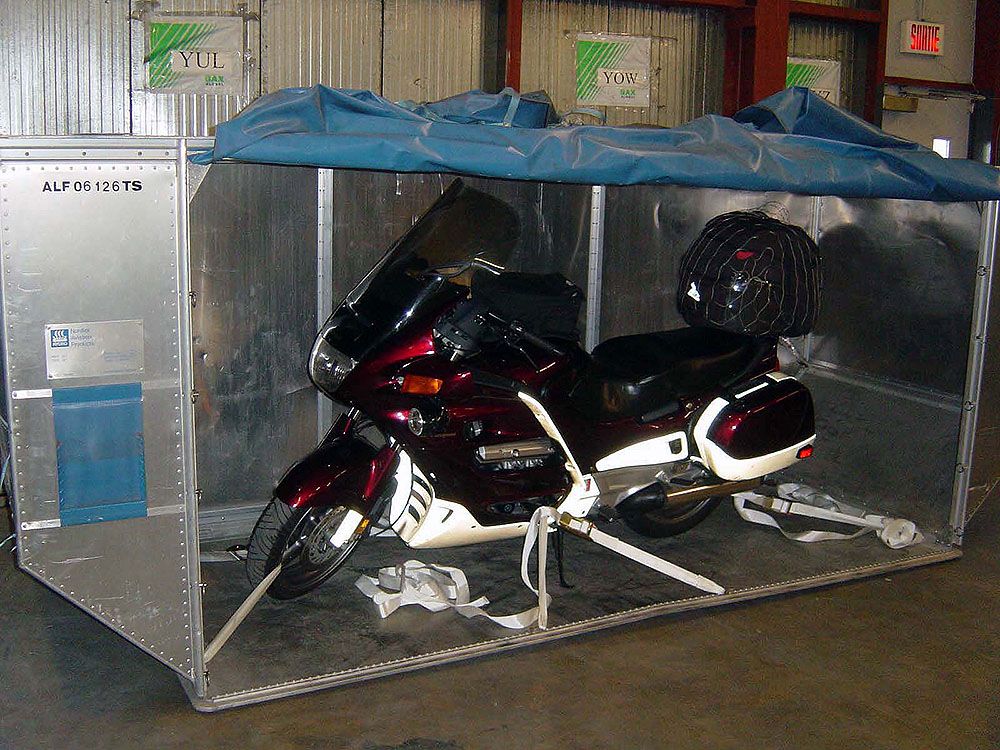
 Example of when you don't have to drain the fuel totally, and don't need a sticker to identify the thing
It would be pretty hard to load this anyway except right side up, or fail to recognize that it is a motorcycle.
Example of when you don't have to drain the fuel totally, and don't need a sticker to identify the thing
It would be pretty hard to load this anyway except right side up, or fail to recognize that it is a motorcycle.
Last edited by PanEuropean; 24 Mar 2015 at 18:52.
Reason: re-hosted missing images
|
16 Jun 2006
|
|
Gold Member
Veteran HUBBer
|
|
Join Date: Jan 2002
Location: Toronto, Canada
Posts: 2,125
|
|
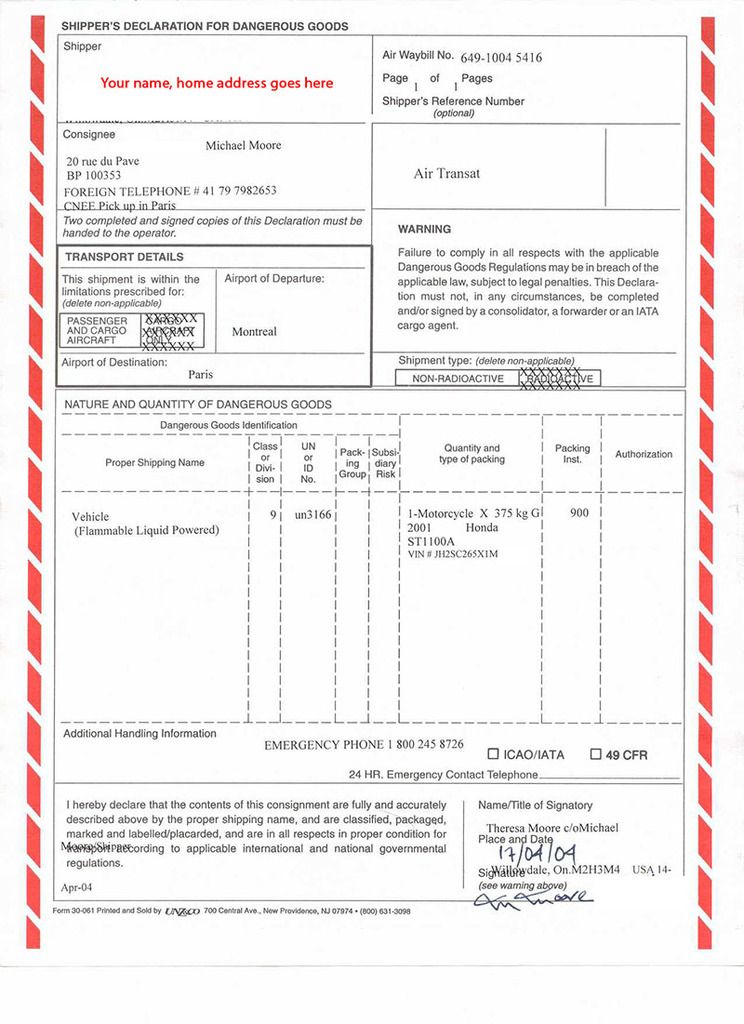
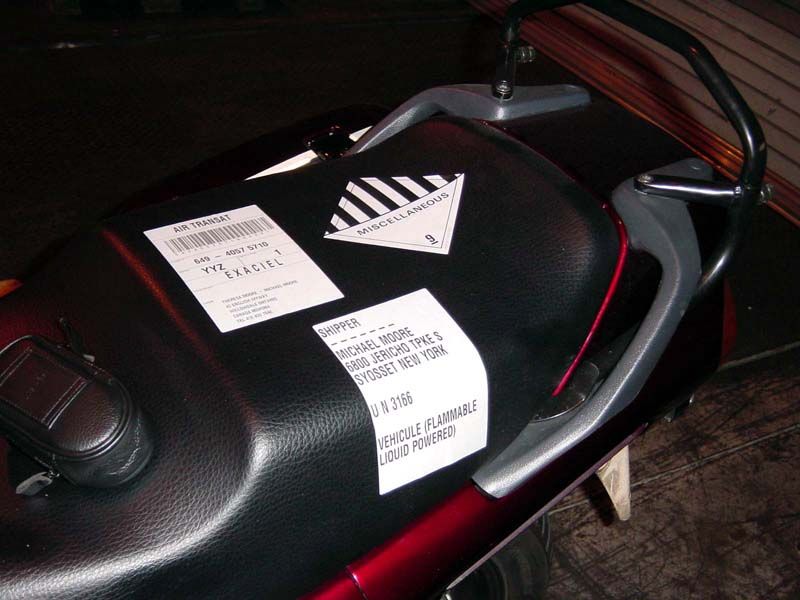
Below is a scan of the DGR form that I used when I last shipped my motorcycle by air. The second image is of a DG sticker (class 9 sticker) that were placed on my motorcycle.
The rules have changed fractionally since I made this shipment a few years ago - the moto no longer needs to have the DG sticker put on it if it is NOT crated. In other words, if it is obvious from looking at the shipment that the thing is a motorcycle (i.e. it is not concealed inside a box or crate), then you don't have to sticker it.
You really have to cross the T's and dot the I's on the DG forms. Even something as simple as using lowercase when you should use uppercase can cause problems. Although the air carriers are not allowed to complete the form for you, it is certainly reasonable to ask them to check the form to make sure you have filled it out properly and not made any errors. In other words, the law forbids the airline employee from filling out the form for you, regardless of how helpful they want to be. But, the law does not forbid them from reviewing the form with you to make sure that you have filled it out properly, and pointing out any errors or omissions you have made.
All I have ever done so far as preparing my motorcycle for shipment is concerned has been to show up with less than 1/4 of a tank of gas, and disconnect and tape off the positive battery terminal. Nowadays, you don't even have to disconnect and tape off the battery terminal, although some 'old time dudes' might ask you to do that if they are not fully aware of the recent changes to the packing instruction. If you have a locking gas cap, make sure you leave the cap unlocked, so that the cargo handlers can check fuel tank contents if they wish to do so. This is very important.
It is not necessary under any circumstances to leave the keys of your motorcycle with the airline when you drop it off. As long as they can satisfy themselves that the fuel tank is less than 1/4 full once you have gone, that's all you have to worry about. So - if your gas cap locks automatically, you might need to leave a key. If this is the case, tie the key to the bike with a strong rope so it does not get lost, and tape the end of the rope that has the key so that the key is obvious, right beside the gas cap.
If you have anything inside your panniers (saddle bags), then make sure that you show the cargo acceptance agent EVERYTHING that is in those saddlebags before you leave the drop-off point. It is in your interest to dump the entire contents of the saddlebags out. Whatever you do, don't accidentally pack some prohibited substance (camping fuel, an aerosol can, a pressurized tire inflation cylinder, etc.) in the panniers by mistake. I usually fill my panniers with soft clothing, underwear, riding gear, and helmets, and take anything that might be considered even remotely questionable with me as my checked baggage.
Michael
Example of a completed DG declaration
 DG Labeling for the moto
not legally necessary, because it is obvious that this is a motorcycle, but some freight receiving agents want the labels in any case.
DG Labeling for the moto
not legally necessary, because it is obvious that this is a motorcycle, but some freight receiving agents want the labels in any case.

Last edited by PanEuropean; 24 Mar 2015 at 19:02.
Reason: re-host missing photos
|
16 Jun 2006
|
|
Contributing Member
Veteran HUBBer
|
|
Join Date: Jul 2002
Location: Sydney, NSW, Australia
Posts: 1,362
|
|
|
Excelent posting there ... much tanks.
You might like to blur the image where it has your details ...
Other than that it should go into the FAQ section... with teh date so 'we' know how old the information is.
__________________
---
Regards Frank Warner
motorcycles BMW R80 G/S 1981, BMW K11LT 1993, BMW K75 G/S
|
16 Jun 2006
|
|
Gold Member
Veteran HUBBer
|
|
Join Date: Jan 2002
Location: Toronto, Canada
Posts: 2,125
|
|
|
Hi Frank:
Ah, I'm not worried about that. It's not my home address anyway - it's the address of the freight forwarder that I used!
|
24 Mar 2015
|
|
Gold Member
Veteran HUBBer
|
|
Join Date: Jan 2002
Location: Toronto, Canada
Posts: 2,125
|
|
|
I have updated this post, which I made 8 years ago, by re-hosting the images that I had originally attached to the post.
IN PRINCIPLE, all the information should still be conceptually correct. But it is very possible that the Dangerous Goods regulations pertaining to UN class 3166 (vehicle, flammable liquid powered) and packing instruction 900 (how items belonging to UN class 3166 must be packed and documented for air shipment) may have changed since then.
The photo of the DG regulations in the first post at the top of this thread is a photo from the 2004 DG book!!!! That's because I did this shipment and took these photos back in 2004. So, go to a freight shed and ask to look at a current copy of the IATA Dangerous Goods Regulations (DGR) book before you ship. IATA issues a new copy of the book every year, hence, you need to look at a book with this year's date on the cover to ensure you are looking at accurate, up to date information.
Michael
|
|
Currently Active Users Viewing This Thread: 1 (0 Registered Users and/or Members and 1 guests)
|
|
|
 Posting Rules
|
You may not post new threads
You may not post replies
You may not post attachments
You may not edit your posts
HTML code is Off
|
|
|
|
Check the RAW segments; Grant, your HU host is on every month!
Episodes below to listen to while you, err, pretend to do something or other...
2020 Edition of Chris Scott's Adventure Motorcycling Handbook.
"Ultimate global guide for red-blooded bikers planning overseas exploration. Covers choice & preparation of best bike, shipping overseas, baggage design, riding techniques, travel health, visas, documentation, safety and useful addresses." Recommended. (Grant)

Ripcord Rescue Travel Insurance™ combines into a single integrated program the best evacuation and rescue with the premier travel insurance coverages designed for adventurers.
Led by special operations veterans, Stanford Medicine affiliated physicians, paramedics and other travel experts, Ripcord is perfect for adventure seekers, climbers, skiers, sports enthusiasts, hunters, international travelers, humanitarian efforts, expeditions and more.
Ripcord travel protection is now available for ALL nationalities, and travel is covered on motorcycles of all sizes!
What others say about HU...
"This site is the BIBLE for international bike travelers." Greg, Australia
"Thank you! The web site, The travels, The insight, The inspiration, Everything, just thanks." Colin, UK
"My friend and I are planning a trip from Singapore to England... We found (the HU) site invaluable as an aid to planning and have based a lot of our purchases (bikes, riding gear, etc.) on what we have learned from this site." Phil, Australia
"I for one always had an adventurous spirit, but you and Susan lit the fire for my trip and I'll be forever grateful for what you two do to inspire others to just do it." Brent, USA
"Your website is a mecca of valuable information and the (video) series is informative, entertaining, and inspiring!" Jennifer, Canada
"Your worldwide organisation and events are the Go To places to for all serious touring and aspiring touring bikers." Trevor, South Africa
"This is the answer to all my questions." Haydn, Australia
"Keep going the excellent work you are doing for Horizons Unlimited - I love it!" Thomas, Germany
Lots more comments here!

Diaries of a compulsive traveller
by Graham Field
Book, eBook, Audiobook
"A compelling, honest, inspiring and entertaining writing style with a built-in feel-good factor" Get them NOW from the authors' website and Amazon.com, Amazon.ca, Amazon.co.uk.
Back Road Map Books and Backroad GPS Maps for all of Canada - a must have!
New to Horizons Unlimited?
New to motorcycle travelling? New to the HU site? Confused? Too many options? It's really very simple - just 4 easy steps!
Horizons Unlimited was founded in 1997 by Grant and Susan Johnson following their journey around the world on a BMW R80G/S.
 Read more about Grant & Susan's story
Membership - help keep us going!
Horizons Unlimited is not a big multi-national company, just two people who love motorcycle travel and have grown what started as a hobby in 1997 into a full time job (usually 8-10 hours per day and 7 days a week) and a labour of love. To keep it going and a roof over our heads, we run events all over the world with the help of volunteers; we sell inspirational and informative DVDs; we have a few selected advertisers; and we make a small amount from memberships.
You don't have to be a Member to come to an HU meeting, access the website, or ask questions on the HUBB. What you get for your membership contribution is our sincere gratitude, good karma and knowing that you're helping to keep the motorcycle travel dream alive. Contributing Members and Gold Members do get additional features on the HUBB. Here's a list of all the Member benefits on the HUBB.
|
|
|










 Linear Mode


