




Grant and Susan in Tunisia
March 10, 1997 - Hammamet, Tunisia (near Tunis)
We have finally made it to Africa! Or, at least the tourist part of North Africa. More on that to follow. Friday we took the ferry from Marseilles. It is a very expensive ferry, in fact it's cheaper to fly from France to Tunis than to take the boat. So, most people taking the boat are there because they want to have their vehicles with them. In the case of returning Tunisians, they are "loaded to the gunwales" with stuff they buy in Europe and take home. Typical vehicles have huge bundles tied 2 metres high on the roof and overflowing the sides as well as being stuffed full to the roof inside. We cleared customs with no problems at all, (and no inspection), but there were long rows of cars being unloaded and inspected when we were leaving.
When we saw all the forms we had to fill out for Tunisia (in Arabic and French captions), we were a little apprehensive, but everyone at the dock was polite and helpful (and all spoke French, which helped). The whole process took only about half an hour, and we discovered we had filled in some forms unnecessarily, since they gave them back to us. Unlike Spain, Grant has to do all the talking (I am only a woman, after all!), which is very relaxing for me. We found the road to our destination fairly easily, as the signs were in both French and Arabic, and arrived at the hotel within a couple of hours of docking.
We didn't see much of Tunis, the capital, except the area between the docks and the highway, but it reminded us of Central America. And, unlike the European blasé attitude, everyone was staring openly at the bike and us. Cars passed us with all the passengers trying to get a good look at us as we navigated around.
We are at the Sheraton Hammamet Resort, which was about $40 US a night including breakfast. In fact, we ended up here because I wanted to have someplace reserved for our first few days, and this was the cheapest hotel in Tunisia that's in the EasySabre reservation system! But, it's still a Sheraton, and the rate is very low because it's the tail end of the low season. This room costs $160 a night in August. It's quite a nice big room with it's own balcony, international direct dial phones, the hotel is on the beach, the food is great. And, la piece de resistance (see, I do know some French words): we have CNN, BBC World, EuroSport and NBC all in English, which was a real treat.
Of course, this isn't really Africa, nor even really Tunisia. Surrounded by European tourists, the only Tunisians we've seen are the hotel staff. However, tomorrow we go back to Tunis to start the process of getting visas for Egypt and Libya. Since Hammamet is only about 50 miles from Tunis on the north east coast, we've decided to base here for a few more days and drive into town to do that. Hopefully we can get into serious touring around by next week.
March 27, 1997 - Jendoubah, Tunisia
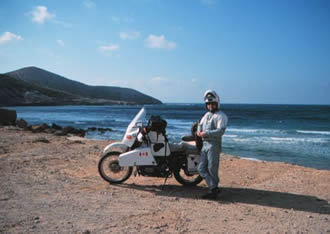
Grant and BMW at Cap Blanc, northernmost point in Africa, Tunisia
From Hammamet we drove to Bizerte, near Cap Blanc, the most northerly point in Africa, and another milestone at N37º 20.053', E009º 50.855 on the GPS. Not much there, and few tourists. Not much interest in this compared to the northernmost point of Europe! Continued back through Bizerte, via Mateur to Tabarka. Long, slow, twisty, hilly road - and this is the main road highway from Tunis. Grant got a bad cough, starting in Tabarka, which is a touristy area with reasonable hotels. However, they were booked solid over the weekend, as the Thursday was the Tunisian independence (from France - declared in 1956, accepted in 59, French finally left in 61 after some very bloody messes) day celebrations, and all the tourist resorts were full to the top. So, although he wasn't feeling very good, we headed inland to the non-touristy areas, arriving in Jendoubah, a little farming town not far from the Algerian border - but far enough - and a hundred or so miles south of the Med.
We did stop at some Roman ruins on the way. Very impressive remains from 200 BC, still useable amphitheatre and underground dwellings, impressive mosaics on the floors, baths etc. still there. We also saw some Carthaginian ruins on the coast at Kerkouane, mostly just foundations but some mosaics and drainage systems for an intact hip bath and other oddments still there, all dating from CA. 600 BC. It was all rediscovered in 1952, abandoned and untouched for almost 2500 years. Funny how in North America anything from the 1800's is old, and in Europe we found medieval ruins dating from the 1100's, which European's consider old. However, Tunisia has some REALLY OLD ruins.
Susan is getting around Jendoubah while Grant recuperates, doing the daily shopping, wonderful fresh fruits, esp. oranges and strawberries and tomatoes. Lots of french bread loaves at only 10 cents a loaf - but no other choices of bread at all! Lots of very old-fashioned stores - you stand at the counter and ask for everything, even if you don't see it - either they dig it out from some hidden corner or point down the street to the shop that has it. They will even lead you several blocks to the right shop if necessary. Susan has been taken around from shop to shop to shop looking for something a couple of times. Everybody is very helpful and friendly.
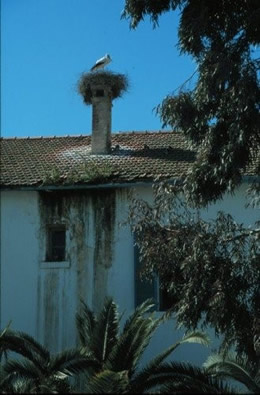
Birds nest anywhere they like in Jendouba
Not much English spoken, but some, mostly Arabic and French. Apparently all the kids now take Arabic for the first two years in school then French as well, then in grade 7-8 they also take English. They certainly realise the importance of English in business etc. The doctor Grant went to had 2 computers, one brand new Packard Bell with a 17" monitor etc., and we talked about the importance of the Internet etc. He was very up on it, reading a French PC Magazine etc. We had wanted to go online to get our mail, but the hotel couldn't do it, so we asked the doctor. He couldn't dial out direct, he was still waiting (I got the impression - his English was only fair and my French is lousy - that he had been waiting a while, perhaps 4 or 5 months) to get the line changed to enable direct overseas dialling. Oh well.
That evening, he just showed up at our room, said come, I have a friend, you can use his phone to dial. So we piled into his friend's car, three in the back with a kid on somebody's lap and two in the front with another kid on the doctor's lap in a tiny little car, and went to - a gas station. The friend who owns the gas station had a fax that could dial overseas direct. Unplugged the fax, and away we went. Finally we got our mail - all 47 pieces!
In the end, when we tried to pay for the calls, they refused any payment! They were all quite fascinated by the process, and I think it was well worth the entertainment price to them. There isn't much to do here. The number one entertainment is sitting in the cafes drinking Tunisian tea - tiny little cups with no handles and very very thick, black, extremely sweet tea. Gaaah! And absolutely no women in any of the cafes by the way, strictly men.
Tunisia is technically equal rights for men and women, full vote etc., but is still clearly Arab and Muslim in many ways, although nowhere near fundamentalist. The women are often dressed just as we would expect any western women to dress, but you still see many, particularly the older ones, with a light knee length robe wrapped over their head and held at the throat by one hand - never tied or pinned, so one hand is always occupied, except when they have a kid in one hand and groceries in the other, then they hold the robe in their teeth!
We hope to do a little sight-seeing tomorrow, as Grant is feeling much better after a stack of pills and shots from the doctor - 4 shots in 4 separate trips, including the first house call, all for $15.00. Pretty cheap! He could have had the shots done at the pharmacy, apparently they do it all the time, but felt better with the doctor doing it.
April 4, 1997 - Gafsa, Tunisia
We finally left Jendoubah a week ago Sunday, and made it to Teboursouk, which has some very impressive Roman ruins nearby at Dougga, spent the better part of a day wandering around there, following another day of rest for Grant.
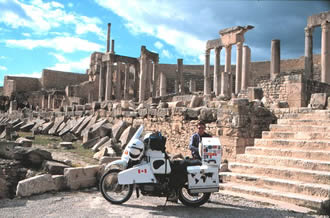
Susan and BMW at ruins of Dougga, Tunisia
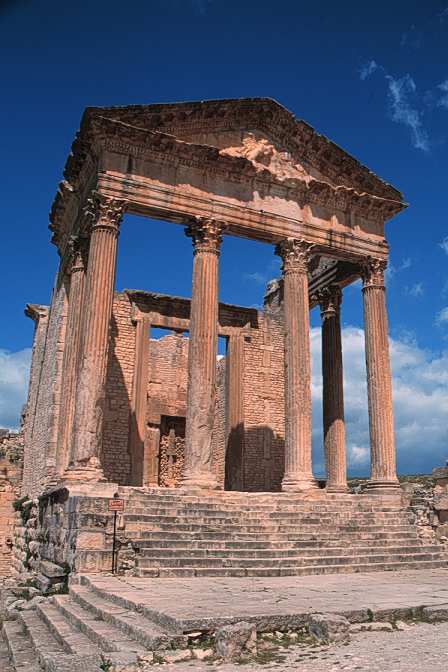
Capitoline Temple, Roman ruins of Dougga, Teboursouk, Tunisia
The day we were scheduled to leave it poured rain and crashed thunder etc., so we wussed out and stayed over the day.
Yesterday we headed south to the less inhabited part of Tunisia, on a road not far from Algeria and not much traversed by tourists. We got stopped a few times by the traffic police (lots of them on every major crossroads, it seems), who all ride white BMW motorcycles and think we're kindred spirits, since that's what we ride too. Anyway, they did want to know where we were going, and to welcome us to Tunisia. When we say we're Canadian, though, everyone says "Ah, oui, Quebec?", to which we're forced to answer, "Non, Vancouver, Anglais". Most of Tunisia seems to think everyone in Canada speaks French. We have to keep explaining that most of Canada is not Quebec, and that it's a very big country. The map on the side of the bike is useful for that.
Everybody is very friendly, all the kids wave as we go by, and many of the adults too. Occasionally the kids will yell something in Arabic, and they might be yelling "Death to the infidels!" for all we know, although they're usually smiling so probably not.
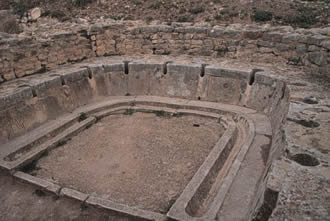
Forica - communal toilet in Dougga Roman ruins, Tunisia
We are now in Gafsa near the big salt lake in about the middle western part of Tunisia. We may be here for a few days, as Susan has now come down with something which looks suspiciously like what Grant had. However, this hotel has TV with NBC in English, as well as a phone in the room, and it's close to the town shops so we can get fruit and fresh bread daily. The oranges here are the best we've ever had, and that includes Spain, so we've been buying them and squeezing them for our morning juice.
Also, strawberries are in season and quite cheap (eat your hearts out, northerners!), as well as pears and melons. So, we're not suffering too much.
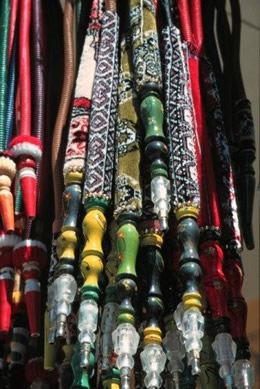
Hookah pipes, market, Gafsa
We spent a lot of time considering alternatives to overland through Libya for getting to Egypt. Gerri and Margaret have been checking on ferries to Alexandria via Greece, Cyprus, Rhodes and Lebanon! But Libya is a much simpler route, and things are looking promising for going that way, finally in progress. It looks like in lieu of joining an organized tour, that we'll end up escorted through Libya from the Tunisian border to the Egyptian border with a car and driver/guide for 5 days. Since all the road signs are only in Arabic, that has some advantages. I guess Libya wants tourists but wants to make sure they keep an eye on them, not let them spread dangerous ideas to the locals. Anyway, the arrangements with the travel agency in Libya will take at least 9-10 days to result in a visa, which we will have to return to Tunis to pick up, so we'll be in Tunisia for another couple of weeks anyway.
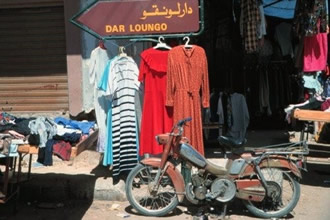
Mopeds are a popular means of transport in Gafsa, Tunisia
April 13, 1997 - Tozeur, Tunisia
We stayed for over a week in Gafsa, mostly because of laziness and bad weather. The hotel there had TV with NBC in English, so that probably had an influence, too. I knew we had stayed too long when we were seriously contemplating staying another night just so we could watch the Profiler series on Saturday night!
Before leaving Gafsa, we had our first dinner at a private home here in Tunisia. Nejib Ali, who we met last week when he introduced himself to us outside the hotel and said he was looking for information about studying in Canada called us and invited us to his house for dinner. I was a little apprehensive, but he had seemed harmless enough, so we said OK. It was a very interesting evening.
Nejib picked us up with his brother, Makhmat, and drove us to a part of Gafsa tourists don't see. We met his brother's wife Nahdia, who was very sweet and friendly and their sister (Selam?), plus niece Inez and young nephew whose name escapes me. His parents also live there but we saw them only briefly, although I suspect his mother and sister cooked the meal. The house has living and sleeping rooms all around a central courtyard, which is not very interestingly landscaped. From the outside the houses are very nondescript, essentially just solid cement walls, and of course, very private as all the rooms windows/doors are on the central courtyard. The room where we ate consisted of just mattresses on the floor with a TV, and not "luxurious" at all by our standards. But, his brother drives a Mercedes, so obviously makes some money working for the state electricity company as an engineer. Nejib teaches English here at high school level.
Makhmat spoke French (better than ours, but not great) and Arabic. So, Nejib did most translating from English to Arabic, but when he left the room, we muddled along in French with his brother. His brother conveyed in French that they are not religious Muslims, by which he meant they don't pray regularly, but my impression is they're still somewhat conservative in dress/habits. He gave us some insights into local customs. For example, it is not considered acceptable here in southern Tunisia for women to go to cafes unless accompanied by their husbands, (very rarely done even though acceptable) although there are now some restaurants where men and women go together. I must note that I never saw another woman in a restaurant during the week + we spent in Gafsa (even in the hotel's restaurant). And Nahdia (Makhmat's wife) only took her head covering off after dinner for a short time (once we were no longer strangers?)
The kids were adorable especially the little girl who is almost 4 and blond (her mother turns out to be blond when she finally took off her head covering). We had balloons which went over well! Before dinner, Grant was asked for opinions on what computer Makhmat should buy for his kids and provided him with a list of specifications.
Food was excellent, consisting of chorba, a Tunisian soup which was MUCH better than the hotel versions we've had, spaghetti with a somewhat spicy sauce with potatoes and meat, salad (in a single plate that everybody ate from with their forks) and fresh fruit for dessert. They brought bowls of water for us to wash our hands in before we ate, and Grant apologized in advance for using his left hand (he is left handed). But, they used spoons, forks, etc. anyway, nobody ate with their hands. Another myth shattered.
At the end of the evening, both women hugged and kissed me, and shook hands with Grant. Nejib and his brother drove us back to the hotel, and insisted we call them if we found ourselves in Gafsa again. So, we had an interesting and enjoyable evening in the real Tunisia.
Saturday we headed out to Tozeur, only 100 km south of Gafsa, which is where we are now. Toured Paradis Gardens and Zoo of Sahara - walked from hotel - LONG walk, took a horse drawn wagon back. Gardens are nice but not spectacular, ones at the hotel are similar. The zoo is somewhat depressing, wouldn't win any prizes for animal treatment. A few camels (one showing definite stress symptoms), foxes and ostriches.
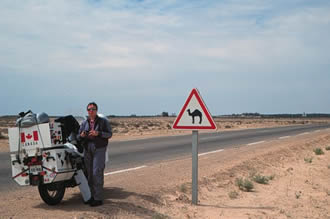
Susan and BMW on road across Chott el Jerid, Tunisia
April 17, 1997 - Douz, Tunisia
Leaving Tozeur, we crossed the Chott el Jerid, which is essentially a large (perhaps 8,000 square kilometers in total), reddish, barren salt flat, the largest in a series stretching from the Mediterranean deep into Algeria. From the description in Cadogans' guide book, it is hot and desolate in the summer time, and mirages are not uncommon. So, we fortified ourselves with extra water and strawberries! Turns out, since they've had some rain recently, it was mostly under water, but probably less than an inch, as you can see tire tracks in it.
Contemplated schemes for the Chott in the past have included building a canal west from the Mediterranean, thereby turning Nefta, a dusty desert town, into a seaport. The most bizarre one, though, is that in 1962, the American suggested that their Ploughshare Program, to investigate the 'peaceful uses of nuclear weapons', might be used to blast a lake in the Chott, creating, according to their estimates, "minimal, and certainly containable, radiation". None of these ideas ever came to fruition, probably a good thing.
Numerous oasis towns are on the edge of the Chott, all fairly quiet and sleepy. We saw our first bunch of camels on the road into Douz, they came right towards us out of the desert and crossed the road to the other side, so we got lots of good pictures. Of course, it's like the kangaroos in Australia, the locals don't think anything of it, the camel herders were probably saying "look at those dumb tourists taking pictures of camels!"

Yes, there really are camels crossing here!
We did the obligatory camel ride into the desert in Douz (dressed in Bedouin outfits with black and white vertical stripes that look like prison garb, so not very photogenic). The hotel talked us into going out for 2 hours, and we were glad we did. We went out at 5:00 p.m. and came back just after sunset, so the light was lovely, the temperature was nice, we really enjoyed the motion, once you got into the rhythm with it. Best of all, we were ahead of the tourist crowd, so there was just us and the camels and the guide. We stopped after an hour in a desert-y spot, and took some pictures, and also got some nice silhouettes of us on the camels against the tall dunes.
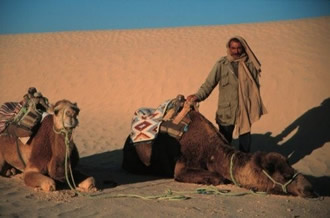
Camels and driver in desert near Douz, Tunisia
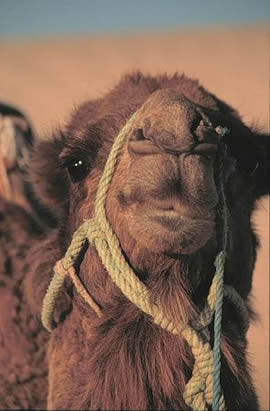
Camel close up and personal - they're so ugly they're cute
On the return, we heard a thundering of hooves coming from the left, and over a sand dune raced a Bedouin on a horse swinging a sword! He was wearing full Bedouin horseman garb, fancy purples and gold tasseled horse blanket etc., and proceeded to stand, sword raised, on the saddle of his horse and pose for his picture to be taken, followed by a handstand! One dinar please, thank you, and he raced off to find some more tourists. Talk about entrepreneurial spirit!
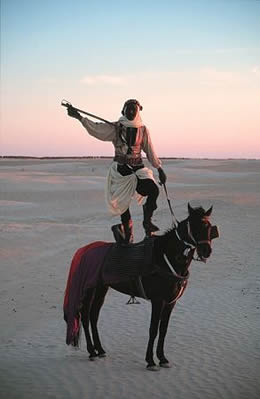
Bedouin posing on camel - desert near Douz, Tunisia
That evening after dinner, we went back out into the desert just far enough to get away from the hotel lights, and sat in the dunes and watched the Hale-Bopp comet, which was very nice and romantic.
April 19, 1997 - Sousse, Tunisia
After we'd done the camel ride, we left Douz Thursday morning, as there didn't seem to be much else to do there, and we couldn't really justify hanging around in a luxury hotel just from sheer laziness. So we went to Matmata, which is 'famous' for having been used as the location for some scenes from the Star Wars movies. It is rolling hills, in which people have for centuries carved out homes in the hard, clay-like soil. They sort of resemble volcanoes, and you can look in at the "courtyard" and see the rooms like caves around the edges. We took lots of pictures, as it's sort of hard to describe, but kind of neat.
However, we found Matmata had the only really obnoxious kids we've seen in Tunisia. Starting with the kid of about 8 or so who started in on us while we were checking into the hotel - "give me a dinar... give me a pen... give me a candy... give me your watch... give me your helmet, etc." Not sure how much success he gets with that routine: "Sure, kid, take my helmet - I don't need it anyway." I guess we'll get more of these as we get further south in Africa, but this kid did not look impoverished, poorly dressed or fed, just a little scrounger. There were lots of his type around unfortunately, so it spoiled the place for us. They don't offer to do anything for the money or whatever, just want a handout, and you can't get away from them.
Lots of interesting cave dwellings on leaving Matmata, including one inhabited by a woman who charges 2 TD (US$2) each to come in and take pictures of her and the place. En route to Sousse we met a Dutch couple from Amsterdam, Ybo and Jemmie, on a motorcycle pulling a trailer, and they stopped to have lunch with us. Their travels had taken them into southern Algeria, and they had absolutely no difficulties, felt the troubles were over-hyped by the government and the media. That always seems to be the way, people travelling through even the supposedly worst places say no problems.
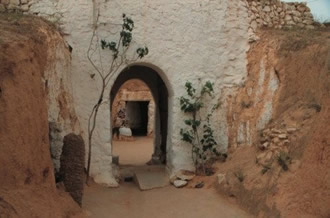
Entrance to underground home, Matamata, Tunisia
Back on the coast in Sousse, our room overlooks the ocean, and we were lulled to sleep by the sound of the surf last night, very nice after being in the interior all this time.
April 30, 1997 - Hammamet, Tunisia
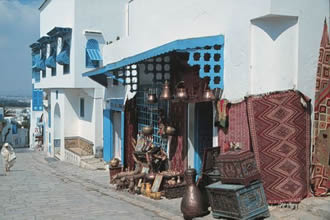
Sidi Bou Said, northern Tunisia - claimed the prettiest town in Tunisia
We're back in Hammamet at the Sheraton, which really is full circle in Tunisia. Enjoying the food and the pampering, (not that we've been very deprived in Tunisia), and Grant is doing a tune up on the bike and a tire change prior to heading into Libya. We got our visa on Friday, valid for 30 days, and as far as the Canadian Embassy's translator could tell (it's all in Arabic), there aren't any restrictions on it. We've advised ITC, the Libyan travel agency, that we expect to get to Bengardane, the largest Tunisian town on this side of the border, by Friday night, so that would put us crossing the border on Saturday, 3 May. ITC has proposed an ambitious 7 day schedule, but at US$300 a day for the car and minder, we don't want to linger either. I doubt we'll be more than 10-12 days in total, that would put us into Egypt by mid-May or earlier.
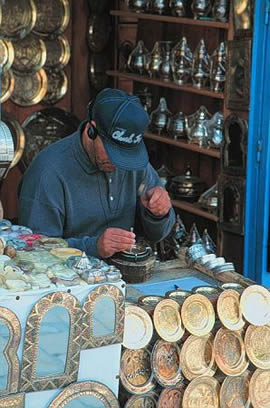
Modern craftsman enjoys music while he works - Sidi Bou Said, Tunisia

Global Rescue is the premier provider of medical, security and evacuation services worldwide and is the only company that will come to you, wherever you are, and evacuate you to your home hospital of choice.
Additionally, Global Rescue places no restrictions on country of citizenship - all nationalities are eligible to sign-up! Travel medical insurance is also available, currently the limit is 90 days. (TIP: For Evac insurance - Click Multiple Trips and 365 days to get year long insurance.)

Ripcord Rescue Travel Insurance™ combines into a single integrated program the best evacuation and rescue with the premier travel insurance coverages designed for adventurers.
Led by special operations veterans, Stanford Medicine affiliated physicians, paramedics and other travel experts, Ripcord is perfect for adventure seekers, climbers, skiers, sports enthusiasts, hunters, international travelers, humanitarian efforts, expeditions and more.
Ripcord travel protection is now available for ALL nationalities, and travel is covered on motorcycles of all sizes! NOTE: Travel medical insurance currently has a limit of 90 days.
Member login
Announcements
Thinking about traveling? Not sure about the whole thing? Watch the HU Achievable Dream Video Trailers and then get ALL the information you need to get inspired and learn how to travel anywhere in the world!
Have YOU ever wondered who has ridden around the world? We did too - and now here's the list of Circumnavigators!
Check it out now, and add your information if we didn't find you.
Are you an Overland Adventure Traveller?
Does the smell of spices wafting through the air make you think of Zanzibar, a cacophony of honking horns is Cairo, or a swirl of brilliantly patterned clothing Guatemala? Then this is the site for you!
Hosted by Grant and Susan Johnson, RTW 1987-1998
Johnson's Home
Who Are We?
The BIKE Story
Press Stories about us
Our "Rules of the Road"
Photo Album 500+ images
"Quick" highlights -
Top 31 photos
Mexico
Central America
New Zealand
Australia
Europe
England
Isle
of Man
Norway
Sweden
Denmark
Germany
Netherlands
Spain
Gibraltar
Africa
Tunisia
Libya
Egypt
Kenya
Tanzania
Malawi
Zimbabwe
Botswana
Namibia
Caprivi Strip
Etosha
Sossusvlei
South
Africa
South America
Argentina
Tierra del Fuego
Chile
Peru
Ecuador
Colombia
Next HU Events

HU Event and other updates on the HUBB Forum "Traveller's Advisories" thread.
ALL Dates subject to change.
2024:
- California: April 18-21
- Virginia: April 25-28
- Germany Summer: May 9-12
- Québec: May 17-19
- Bulgaria Mini: July 5-7
- CanWest: July 11-14
- Switzerland: August 15-18
- Romania: August 30-Sept 1
- Ecuador: August 24-25
- Austria: September 12-15
- France: September 20-22
- Queensland is back! Oct 4-7
- Germany Autumn: Oct 31-Nov.3
- South Africa: November
Add yourself to the Updates List for each event!
Questions about an event? Ask here
HU Achievable Dream is Online
and available now to stream on Vimeo!
ALL 15 chapters of the HU Achievable Dream Guide are available to download on Vimeo!

Binge watch over 18 hours of inspiring, informative and entertaining stories and tips from 150 travellers!
"a cross between entertaining stories, tech tips, and reference guide"
"A timeless introduction to Motorcycle Adventure Travel!"
Originally launched as a 7 DVD set, The Achievable Dream series can now be downloaded anywhere. OVER 18 hours of solid info take up zero space in your panniers. How convenient!
Books

All the best travel books and videos listed and often reviewed on HU's famous Books page. Check it out and get great travel books from all over the world.
NOTE: As an Amazon Affiliate we earn from qualifying purchases - thanks for your help supporting HU when you start from an HU Amazon link!