




Living on the Road
Accommodation
Motorcycle friendly campgrounds, motels, hotels. We plan to add new listings as we hear about them, and to create a form which will allow you to provide us with information easily to do so.

Bente Brathen checking in with bike - Photo © Dag Jenssen, Rocinantes Travels
Also see the Horizons Unlimited bulleting board for postings under the following categories:
Bike friendly hotels, motels and campgrounds in North America
Bike friendly hotels, motels and campgrounds in the rest of the world: Africa, Australia / New Zealand, Central America and Mexico, Europe, Middle East, Northern Asia, Southern Asia, South America, other.
Helpful People en route!
Friendly folk from Thailand, India, Japan, Turkey, Belgium, UK, Norway, Germany, Africa, Canada, USA, Australia, New Zealand, Colombia and more are listed in this section of the Links page.
These are not to be confused with paid providers of accommodation, which can be found on the same page!
For further contacts in many more areas , go to the Horizons Unlimited Motorcycle Travellers Community page. We now have over 130 communities all over the world .
Our Rules of the Road - "things we have learned - often the hard way!"
1. Just because the next town on your route is on the map doesn't mean it's big enough for a gas station.
Often a town is on the map and consists of no more than a couple of mud and twigs huts. It's on the map because it exists and is all there is for a couple of hundred kilometers in any direction. FILL UP OFTEN! Never run below a half tank if you can possibly avoid it. A 400 km range is a good minimum at any time. Grant ignored this rule in the Atacama Desert in northern Chile, and we almost ran out of gas in the middle of the driest desert in the world!
2. NEVER pass by something you need on the assumption that it will be available later. Or cheaper.
It probably won't be. Max, our Italian friend we met in Ushuaia was shocked at US$300.00 for a front tire for his '97 BMW R1100GS at the Santiago, Chile, BMW dealers. He had heard that there were lots of tires at the Zofri (Tax Free Zone) in Iquique, Chile, so passed on it and headed north on a nearly bald Avon trial front. At Iquique - almost nothing. Certainly nothing that would do him - the closest was a 300-19 street front. It was looking like he would have to do the standard last ditch of all travellers - courier it in from somewhere else, in this case the USA would be the cheapest and easiest. This would easily cost him the original horrible US$300.00 he had so violently rejected in Santiago. By sheer good luck, as we were checking out hostals in Arica, Chile, a motorcycle cop pulled up, and in the course of conversation with him, mentioned the tire problem. He said that there was a shop in town that had a good selection. Riding a Japanese 400cc dirt bike, he led us through town at a frantic pace, complete with stopping traffic for us at intersections etc., to a small shop. They had about 20 tires in stock. One of them, a made in Brazil European brand, their very biggest, was a little small, and a straight street tire, but would do, considering the alternatives.
3. Maps are never to be taken as the absolute gospel.
For southern Chile, the maps show a road almost to the very end of the country - there isn't one. The maps show the roads the government would like to have - not the reality. A road in Brazil that is on the map doesn't exist at all, another one isn't on the map, another one marked as paved is mud. A road in Malawi marked as the main route to a town is supposed to be paved - it's a dirt and rock road up a mountainside. And sometimes you get pleasantly surprised, as the road which you thought was gravel has been paved since the map or guidebook was published.
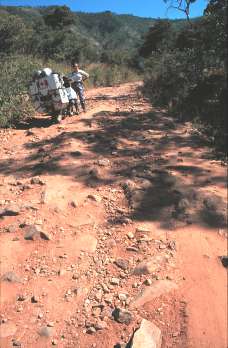
The road to Livingstonia, Malawi

4. BUT, getting directions from locals is haphazard at best.
The local you are asking directions from may never have been out of his little village in the middle of nowhere - but:
doesn't want to admit that; or
doesn't have a clue but genuinely wants to have you go away feeling good - the culture is always to say yes, never no;
thinks he knows but really doesn't understand what you want or where you want to go.
Ask several people - take the most popular answer and cross your fingers, then ask again at the next crossroad.
5. Just because the water is bottled doesn't mean it's good water.
In Kenya, there was a consumer scandal shortly before we arrived there - of 300 or so brands of bottled water available in Kenya, only 3 were not Nairobi tap water, and were considered sufficiently safe to drink. Recommendation - check what the best hotel in town serves for bottled water.
6. There are few, if any, universal preferences regarding food.
For example, breakfast in Canada is often bacon and eggs or pancakes or cereal and whole wheat toast, and we think of that as normal. Northern Europe and especially Scandinavia has great smorgasbords, with cereal, fresh milk and juices, a wide variety of meat and cheese slices and several kinds of wonderful breads. But in much of southern Europe and Africa and South America, breakfast consists of a (white) roll or two slices of (white) bread, maybe with butter, and a cup of coffee or tea. Occasionally scrambled eggs with perhaps a little ham chopped in is available as a special item. If you absolutely must have a particular item for you to consider it breakfast, you'll have to carry it with you. For Susan, it is chocolate spread for toast, which is not always easy to find!
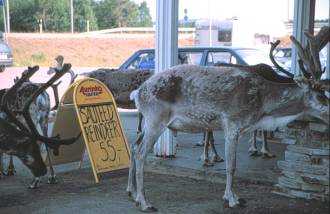
Reindeer, unsuspecting their fate, outside a restaurant in Finland!
This rule also applies to: meal times; what is considered to be normal condiments on a hamburger (to give only a couple of examples, in Argentina it's only the meat and maybe the bun, whereas in Australia it includes fried egg and sliced beet); and especially the definition of rare, medium and well done in relation to meat; etc. etc.
7. In a strange city where you don't speak the language or in any third world country, one practical thing a day is all you can reasonably expect to accomplish.
There aren't usually shopping malls with all the stores you need conveniently grouped together. The yellow pages are often not used by businesses because of the cost of listings, and may be two or three years out of date. Even if you have a map of the city, the actual streets may not be labeled (or labeled correctly). The shops may not have signs. Opening and closing hours are usually not published, but frequently shops are closed in the middle of the day for several hours and/or closed evenings and weekends. etc. etc. NOTE: You can often find things more easily in a smallish town/city than a big city.
8 . Be an opportunistic shopper, especially for unusual items.
An example of this is Susan's particular brand of contact lens solution, since she doesn't like to substitute. We keep at least a month's supply ahead, and almost never pass a pharmacy or optical store in a reasonable sized town without checking for it. Other items in this category - vitamins (in Chile, you can't buy Vitamin C in capsules or swallowable tablets, just chewable or effervescent), tampons, antacid, and of course, any prescription drugs you need.
9. Paperwork and documents - be practical, not paranoid.
For example, if your vehicle registration expires while you're out of the country, you need not fear that the border officials in Africa or South America will be able to log on to the motor vehicle database of your home country/state and determine this fact. As long as you have an official looking document you'll be right. We've met travelers with forged driver's licenses, license plates, carnets, vehicle registrations, etc. Sometimes you are forced to these lengths when bureaucracy intrudes, such as if your home country won't renew your registration when you are overseas. A tip from Jim, an Australian motorcyclist: If you have several good color copies of your driver's license, when corrupt policemen threaten to confiscate it unless you pay them a bribe, you can say: "Go ahead. Keep it!"
10. Be flexible, don't be in a hurry and keep smiling!
These last three will get you through almost any situation. "Stuff" happens, and getting upset about it gets you nowhere. If you don't have much time, compress the area you are trying to cover rather than rushing through. For example, Zimbabwe and Namibia will give you a good cross-section of southern Africa, including wild animals, and can easily be done in two to three weeks.

Global Rescue is the premier provider of medical, security and evacuation services worldwide and is the only company that will come to you, wherever you are, and evacuate you to your home hospital of choice.
Additionally, Global Rescue places no restrictions on country of citizenship - all nationalities are eligible to sign-up! Travel medical insurance is also available, currently the limit is 90 days. (TIP: For Evac insurance - Click Multiple Trips and 365 days to get year long insurance.)
Ripcord Rescue Travel Insurance™ combines into a single integrated program the best evacuation and rescue with the premier travel insurance coverages designed for adventurers.
Led by special operations veterans, Stanford Medicine affiliated physicians, paramedics and other travel experts, Ripcord is perfect for adventure seekers, climbers, skiers, sports enthusiasts, hunters, international travelers, humanitarian efforts, expeditions and more.
Ripcord travel protection is now available for ALL nationalities, and travel is covered on motorcycles of all sizes! NOTE: Travel medical insurance currently has a limit of 90 days.
Member login
Announcements
Thinking about traveling? Not sure about the whole thing? Watch the HU Achievable Dream Video Trailers and then get ALL the information you need to get inspired and learn how to travel anywhere in the world!
Have YOU ever wondered who has ridden around the world? We did too - and now here's the list of Circumnavigators!
Check it out now, and add your information if we didn't find you.
Are you an Overland Adventure Traveller?
Does the smell of spices wafting through the air make you think of Zanzibar, a cacophony of honking horns is Cairo, or a swirl of brilliantly patterned clothing Guatemala? Then this is the site for you!
Hosted by Grant and Susan Johnson, RTW 1987-1998
Next HU Events

HU Event and other updates on the HUBB Forum "Traveller's Advisories" thread.
ALL Dates subject to change.
2024:
- California: April 18-21
- Virginia: April 25-28
- Germany Summer: May 9-12
- Québec: May 17-19
- Bulgaria Mini: July 5-7
- CanWest: July 11-14
- Switzerland: August 15-18
- Romania: August 30-Sept 1
- Ecuador: August 24-25
- Austria: September 12-15
- France: September 20-22
- Queensland is back! Date TBC
- Germany Autumn: Oct 31-Nov.3
- South Africa: November
Add yourself to the Updates List for each event!
Questions about an event? Ask here
HU Achievable Dream is Online
and available now to stream on Vimeo!
ALL 15 chapters of the HU Achievable Dream Guide are available to download on Vimeo!
Binge watch over 18 hours of inspiring, informative and entertaining stories and tips from 150 travellers!
"a cross between entertaining stories, tech tips, and reference guide"
"A timeless introduction to Motorcycle Adventure Travel!"
Originally launched as a 7 DVD set, The Achievable Dream series can now be downloaded anywhere. OVER 18 hours of solid info take up zero space in your panniers. How convenient!
Books

All the best travel books and videos listed and often reviewed on HU's famous Books page. Check it out and get great travel books from all over the world.
NOTE: As an Amazon Affiliate we earn from qualifying purchases - thanks for your help supporting HU when you start from an HU Amazon link!