




Finland
Fact sheet Finland

Finland (Finnish name Suomi) is a republic which became a member of the European Union in 1995. Its population is 5.3 million. The capital Helsinki has 561 000 residents. Finland is an advanced industrial economy: the metal, engineering and electronics industries account for about 60 % of export revenues, the forest products industry for about 20 %. Finland is one of the leading countries in Internet use. Today, there are more mobile phone than fixed network subscriptions.
Forests cover three quarters of the country's surface area of 338 000 sq. km. Other outstanding features of Finland's scenery are some 190 000 lakes and approximately as many islands. The principal archipelago and the self-governing province of the Ã…land Islands lie off the south-west coast while the main lake district, centred on Lake Saimaa, is in the east.
Geography and Nature
Photo: Hannu Vallas
Finland is situated in northern Europe between the 60th and 70th parallels of latitude. A quarter of its total area lies north of the Arctic Circle. Finland's neighbouring countries are Sweden, Norway, and Russia, which have land borders with Finland, and Estonia across the Gulf of Finland. Forest covers about 75 per cent of Finland, while bodies of water - mainly lakes - cover almost 10 per cent. Finland is the most heavily forested country in Europe, with 23 million hectares under forest cover. There are approximately 190,000 lakes and about 180,000 islands. Europe's largest archipelago, which includes the self-governing province of the Ã…land Islands, lies off the south-west coast.
Climate
Photo: Tero Pajukallio
One notable effect of Finland's northerly position on the globe is that the four seasons of the year are clearly distinct from one another. The climate is marked by cold winters and warm summers. The mean annual temperature in the capital, Helsinki, is 5.3 degrees Celsius. The highest daytime temperature in southern Finland during the summer occasionally rises to almost 30 degrees. During the winter months, particularly in January and February, temperatures of minus 20 Celsius are not uncommon. In the far north, beyond the Arctic Circle, the sun does not set for about 73 days, producing the white nights of summer. In the same region, during the winter period, the sun remains below the horizon for 51 days, creating the polar night known in Finnish as kaamos.
The People
© Smile Audiovisual
The population of Finland is 5.3 million. Finland is the sixth largest country in Europe in area, with a low population density of 15.5 persons per square kilometre. Most Finns, some two thirds, now live in urban areas, while one third remain in a rural environment. The capital, Helsinki, and the neighbouring towns, Espoo and Vantaa, form the fast growing Helsinki metropolitan region, which is now home to almost a million Finns. Other important towns are Tampere and Turku in southern Finland, and Oulu in the north. Ethnically, Finland is still a very homogeneous country. The foreign community accounts for about two per cent of the population. The biggest groups of immigrants are from Russia, Estonia and Sweden. Among them are a considerable number of people of Finnish descent.
Languages
Photo: Raino Heinonen
The Finnish language is a member of the Finno-Ugric linguistic family that includes, in one branch, Finnish, Estonian and a number of other Finnic tongues, and in the other, Hungarian, by far the biggest language of the Ugric group. Finland has two official languages, Finnish and Swedish, the latter spoken as a mother tongue by about 6 % of the people. The official status of Swedish has historical roots in the period when Finland was a part of the Swedish realm, a period that lasted from the early 13th century until 1809. Another indigenous language is Sami, spoken within the small community of Sami people in Lapland (also known as Lapps). English has become the most popular foreign language and is widely spoken.
Religion
Photo: Matti Tirri
There has been complete freedom of worship in Finland since 1923. The Evangelical Lutheran Church is the country's biggest denomination while a fraction of Finns belong to the Finnish Orthodox Church. Both denominations are designated as state religions.
History
1155The first missionaries arrive in Finland from Sweden. Finland becomes part of the Swedish realm.1809Sweden surrenders Finland to Russia. The Czar declares Finland an autonomous Grand Duchy with himself as constitutional monarch represented by a governor general.1917Finland declares independence from Russia on December 6.1919The constitution is adopted and Finland becomes a republic with a president as head of state.1939 - 40The Soviet Union attacks Finland and the Winter War is fought.1941 - 44Fighting between Finnish and Soviet forces resumes in the Continuation War. Some territory is ceded to the Soviet Union but Finland is never occupied and preserves its independence and sovereignty.1955Finland joins the United Nations and, in 1956, the Nordic Council.1995Finland becomes a member of the European Union (EU).1999Finland backs European monetary union.2002Banknotes and coins of the EU's single currency, the euro, enter circulation.
Government
Photo: Matti Hurme
The head of state is the President of the Republic who is elected for a period of six years and may serve a maximum of two consecutive terms. The President is chosen by direct popular vote, with a run-off between the two leading candidates if no candidate wins an overall majority in the first round of voting. In 2000, the Finns elected their first female president, Tarja Halonen who was re-elected again in 2006. The Government must enjoy the confidence of parliament (the Eduskunta) which has 200 members elected every four years. In recent decades, the three biggest parties in parliament have consistently been the Social Democratic Party, the Centre Party, and the moderate conservative National Coalition Party. Multiparty coalition governments, the prevailing type, usually include two of the aforementioned parties. The leader of the Government, the Prime Minister, normally comes from the party with the most seats in parliament. Finland's present constitution, adopted in 2000, allocates more power to the Prime Minister than its predecessor did.
Foreign Policy
© UN/DPI Photo
In its foreign policy Finland promotes sustainable development, stability and security in the international community and endeavours to strengthen Finland's international position. Finland attaches special importance to principles such as democracy, the rule of law and human rights, in line with long-established Nordic values.
As a member of the European Union since 1995, Finland is part of an influential body in world politics. Finland is an active member of the Union and supports a further strengthening of its Common Foreign and Security Policy, including its capability to act in crisis management. Finland is also a firm proponent of the Union's enlargement process.
Finland's foreign and security policy is based on military non-alliance and credible national defence. Finland cooperates with NATO in the PfP programme. Finland also has long experience of participation in UN peacekeeping operations.
Finland works actively to strengthen multilateral cooperation, the United Nations and international law in general. Finland has launched the Helsinki Process which aims to improve current global governance structures.
Education and Research
Photo: Tero Pajukallio
Finnish people have a high standard of education. All children receive compulsory basic education between the ages of 7 and 16. Education beyond the age of 16 is voluntary, taking the form of either a three to four-year course in upper secondary school or 2 to 5 years at a vocational school. Finnish higher education consists of two sectors: universities and polytechnics. There are 20 universities and 29 polytechnics in the country. Nearly 60 per cent of the population have completed post-primary education and 13 per cent have a university degree or comparable qualification.
In recent years there has been national focus on research and product development, with special emphasis on information technology.
Industry and the Economy
© UPM-Kymmene
Finland's road to industrialisation started in the 19th century with the harnessing of forest resources. Forests are still Finland's most crucial raw material resource, although the engineering and high technology industries, spearheaded by the Nokia corporation, have long been the leading branches of manufacturing. The industrial structure of Finnish exports has changed dramatically over the past few decades. The wood and paper industry accounted for well over half of exports less than thirty years ago. Now the paper industry is only one of three major export sectors, the other two being electronics and metal and engineering. Electronics is the most spectacular success story in Finnish exports. Its remarkable growth in the 1990s was mainly based on mobile phones and other telecommunication equipment. As for the country's general prosperity, the net wealth of Finnish households is at the average level for member states of the European Union.
- The Media
Photo: Matti Hurme
Finland has approximately 200 newspapers, of which more than a quarter are published 4 to 7 times a week. The total circulation of all newspapers exceeds 3 million. Most newspapers are bought on subscription rather than from news-stands. Finland also has a very high number of magazines; there are about 2,800 genuine weeklies, and if publications appearing at least four times a year are added, the figure reaches 3,500. The print media dominate the mass media economy in Finland and newspaper circulation per capita is the highest in the EU and third highest in the world.
Finland's national public service broadcasting company, YLE, operates five national television channels. There are two privately owned TV channels with national coverage and some thirty local TV stations. Finland has five national radio channels, four of them public service stations and one commercial. Overall, YLE runs thirteen radio channels while the total number of commercial stations exceeds 60.
Culture
© Smile Audiovisual
Music is arguably the Finnish art form most esteemed abroad. An essential feature of Finnish musical education is that even ordinary comprehensive schools can provide enhanced music teaching. This generates a genuine interest in making music, thus educating an open-minded and active future concert public. The towering figure in Finnish music was for many years exclusively the 20th century composer Jean Sibelius. Today, however, Finland has an exceptionally high number of significant composers and conductors. Finnish pop and rock music have also achieved international recognition in the new millennium.
World famous are also Finnish design and architecture. Finnish design became a concept created by its strong tradition, originality, stylishness, high-quality materials and good manufacturing. Products from design-conscious companies such as Marimekko, Iittala, and Arabia have been exported very successfully to the Americas, continental Europe, and Australia. Industrial design has also played an important part in increasing Finland's competitiveness in the 21st century.
The 1950s marked the final breakthrough in international awareness of Finland as a land of progressive architecture. The most influential Finnish architect has undoubtedly been the functionalist Alvar Aalto.
http://virtual.finland.fi/netcomm/news/showarticle.asp?intNWSAID=27443
http://www.visitfinland.com/w5/index.nsf/(pages)/index
Saimaa
From Wikipedia, the free encyclopedia:
Saimaa

View from Joutseno town in western direction.
Location:southeastern Finland
Coordinates:61°15′N 28°15′E
Primary outflows: Vuoksi River, Saimaa Canal
Basin countries:Finland
Surface area:4,400 km² (1,087,264 acres) total
(1,377 km² (340,264 acres) largest basin)
Average depth:17 m (56 ft)
Max. depth:82 m (270 ft)
Water volume:36 km³ (8.6 cu mi)
Shore length(1):13,700 km (8,500 mi)
Surface elevation:76 m (250 ft)
Islands: 3507
Settlements:Lappeenranta, Imatra, Savonlinna, Mikkeli
(1 Shore length is not a well-defined measure.)
Saimaa (is pronounced "saima:"), or Saimen in Swedish, is a lake in southeastern Finland. At approximately 4,400 km² square km, it is the largest lake in Finland, and the fourth largest in Europe. It was formed by glacial melting at the end of the Ice Age. Major towns on the lakeshore include Lappeenranta, Imatra, Savonlinna, Mikkeli, Varkaus, and Joensuu. The Vuoksi River flows from Saimaa to Lake Ladoga. Most of the lake is spotted with islands, and narrow canals divide the lake in many parts, each having their own names (major basins include Orivesi, Puruvesi, Haukivesi, Yövesi, Pihlajavesi, and Pyhäselkä).
The Saimaa Canal from Lappeenranta to Vyborg binds Saimaa to the Gulf of Finland. Other canals bind Saimaa to smaller lakes in Eastern Finland and form a network of waterways. These waterways are mainly used to transport wood, minerals, metals, pulp and other cargo, but also tourists use the waterways.
One of the three fresh water seals, the Saimaa Ringed Seal, lives only at Saimaa.
External links
- www.ymparisto.fi - Saimaa, nimet ja rajaukset (Finnish)
- Saimaa - Finland's largest lake
- http://www.gosaimaa.fi/en/ goSaimaa.fi - Information about Lakeland Finland
http://virtual.finland.fi/netcomm/news/showarticle.asp?intNWSAID=25710
http://www.saimaa.fi/Suomeksi.iw3

Global Rescue is the premier provider of medical, security and evacuation services worldwide and is the only company that will come to you, wherever you are, and evacuate you to your home hospital of choice.
Additionally, Global Rescue places no restrictions on country of citizenship - all nationalities are eligible to sign-up! Travel medical insurance is also available, currently the limit is 90 days. (TIP: For Evac insurance - Click Multiple Trips and 365 days to get year long insurance.)
Ripcord Rescue Travel Insurance™ combines into a single integrated program the best evacuation and rescue with the premier travel insurance coverages designed for adventurers.
Led by special operations veterans, Stanford Medicine affiliated physicians, paramedics and other travel experts, Ripcord is perfect for adventure seekers, climbers, skiers, sports enthusiasts, hunters, international travelers, humanitarian efforts, expeditions and more.
Ripcord travel protection is now available for ALL nationalities, and travel is covered on motorcycles of all sizes! NOTE: Travel medical insurance currently has a limit of 90 days.
Member login
Announcements
Thinking about traveling? Not sure about the whole thing? Watch the HU Achievable Dream Video Trailers and then get ALL the information you need to get inspired and learn how to travel anywhere in the world!
Have YOU ever wondered who has ridden around the world? We did too - and now here's the list of Circumnavigators!
Check it out now, and add your information if we didn't find you.
Are you an Overland Adventure Traveller?
Does the smell of spices wafting through the air make you think of Zanzibar, a cacophony of honking horns is Cairo, or a swirl of brilliantly patterned clothing Guatemala? Then this is the site for you!
Hosted by Grant and Susan Johnson, RTW 1987-1998
Next HU Events

HU Event and other updates on the HUBB Forum "Traveller's Advisories" thread.
ALL Dates subject to change.
2024:
- California: April 18-21
- Virginia: April 25-28
- Germany Summer: May 9-12
- Québec: May 17-19
- Bulgaria Mini: July 5-7
- CanWest: July 11-14
- Switzerland: August 15-18
- Romania: August 30-Sept 1
- Ecuador: August 24-25
- Austria: September 12-15
- France: September 20-22
- Queensland is back! Oct 4-7
- Germany Autumn: Oct 31-Nov.3
- South Africa: November
Add yourself to the Updates List for each event!
Questions about an event? Ask here
HU Achievable Dream is Online
and available now to stream on Vimeo!
ALL 15 chapters of the HU Achievable Dream Guide are available to download on Vimeo!
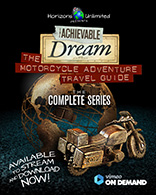
Binge watch over 18 hours of inspiring, informative and entertaining stories and tips from 150 travellers!
"a cross between entertaining stories, tech tips, and reference guide"
"A timeless introduction to Motorcycle Adventure Travel!"
Originally launched as a 7 DVD set, The Achievable Dream series can now be downloaded anywhere. OVER 18 hours of solid info take up zero space in your panniers. How convenient!
Books

All the best travel books and videos listed and often reviewed on HU's famous Books page. Check it out and get great travel books from all over the world.
NOTE: As an Amazon Affiliate we earn from qualifying purchases - thanks for your help supporting HU when you start from an HU Amazon link!