|
  Books Books
Adventure Motorcycling Handbook, by Chris Scott
by Sam Manicom
Sam's plans frequently don't work out as they should...
new challenges and surprises... jailed in Tanzania ...lives in a remote village, canoes a dugout in Malawi, escapes a bush fire and
much more. Get it here!
Into the Den of the Bear and the Lair of the Dragon on a Motorcycle. Werner, 66, was born in Germany and worked in Canada
until his retirement. He has authored a number of books since getting bit
by the motorcycle travel bug, including
-8 Around the Americas by Motorcycle,
-Into the Den of the Bear and the Lair of the Dragon on a Motorcycle,
and
-Africa Against the Clock on a Motorcycle.
All his books are available directly from Werner. Tell him we sent you and get US$5.00 off the regular US$20 price!
For details
on his books see here.

The Producers of Mondo Enduro present
Terra Circa, Around the World by Motorcycle (6 x 20 minute episodes).
Regular readers of this newsletter will
remember Terra Circa's adventures around the world, and especially the Zilov
Gap. Now's your chance to see it in video. Austin Vince is a very funny
guy and the video is hilarious, as he leads his intrepid crew through misadventure
after misadventure.
"This is adventure motorcycling"
says Chris Scott, who wrote the book, so he ought to know!
Contact Aimimage for the PAL video or all format DVD. Don't
forget to tell them you heard about it on HU, we'll make a bit, and it won't cost you any more.
Looking for a travel book for someone special?
Go to our Books
pages, where we have listed some of the best motorcycle
travel books, as well as a number of BMW
books, general motorcycle
books, and travel guides.
There's links to Amazon USA, Amazon UK,
Amazon Canada, and Amazon Deutschland, so no matter where you
are - you can order books at great prices, and we'll make a dollar or a pound
or a Euro, which goes a very little way to supporting this e-zine.
There's also links to search Amazon sites for all their
products, books, CDs etc., and yes, we get a tiny piece of that too. We really
appreciate it when you start your book search from our website. Thanks for
the support!
NOTE: If you buy a book starting with one
of our links below, we get a little bit to help support the website!

 

If you have a book or want a book that you think other
travellers would be interested in please let me know and I'll put it on the
site. Thanks, Grant
Help support your favourite website! Here's
how!
Your Privacy Please be assured that we will NOT under any circumstances,
rent, lease, sell, or give out our mailing list, and/or your name and e-mail
address, to anyone for whatever purpose. Your privacy is assured, and
personally guaranteed.
See our complete Privacy
Policy here.
Grant Johnson, Editor
Administrivia Please note that you are receiving this newsletter
only because you requested it! We are 100% opt - in only.
To subscribe
or UNsubscribe
to this newsletter.
Newsletter
Back issues
All comments and suggestions are carefully read,
and where possible will be acted on. Your help will make this a useful service
for all travellers.
Please use the Bulletin
Board for questions and suggestions.
Advertising:
If you would like to advertise your product or
service in this newsletter or on the website, please contact
me. Ad rates are very reasonable. Details at this link.
ISSN 1703-1397 Horizons Unlimited
Motorcycle Travellers' E-zine - Copyright 1999-2007, Horizons Unlimited and
Grant and Susan Johnson. All rights reserved.
Redistribution - sending it on to friends
is allowed, indeed encouraged, but other than the following requirements,
only with permission. You may forward copies of the Horizons Unlimited Motorcycle
Travellers' e-zine by forwarding it yourself by hand. You must forward the
issue in its entirety, no fee may be involved. Please suggest they Subscribe!
Legal gibberish: (particularly for those in
countries that have more lawyers in one town, just for instance, New York,
not to name any names, than some whole countries, as another example, Japan.
Again, not naming anybody specifically you understand) Recommendations are
based on positive or negative experiences of somebody, somewhere. Your mileage
(kilometrage if you insist) may vary. We are not responsible in any way for
any product or service mentioned, and do not warrant any such mentioned product
or service, and are not responsible for any bad things that may befall you.
You are responsible for yourself! Act accordingly. We check all links and
information given as close as possible to publication, and all info is correct
as best we can determine at that time. |
|
Shorts...
Jason Homewood, UK, Round the world, in Colombia, KTM950,
"In Cartagena I met up with a german biker Mattias, and we wandered down the sail club to see if someone would take us to Panama. We found Carlos, a Portuguese nutcase who agreed to give it a go on his 30ft, 35 year old yacht.
Just one damned adventure after another!
On the first day the flywheel came off the motor, so we were sailing. The 4 day trip took 9 - we got washed up on a reef, I nearly lost the bike off the side, we had a storm and Carlos got the kitchen knife out threatening to cut the bikes off, there was a fight on board (not me), we ran out of food, nearly ran out of water. We had a ghost on board (friendly), the last owner blew his brains out, and there was still the bullet hole in the ceiling, and blood stains on the cushions... It was an adventure all right! Ask me about it when you next see me..."
Brian Bayley, ' Life of Brian-oz style', in Lesotho and South Africa, Suzuki DR650,
"The joy I felt on arriving at the top of Sani Pass is something I hope I remember for a long time. 7 km of rocks, sharp bends, wet/ice corners, changing light, and passing 3/4x4s going the same way while all the while going up hill. No room or want to stop, put the foot down or even slow down to much. I found it rather nerve racking but joyful at the same time. This done fully loaded with gear and fuel, and no one to help me pick it up if something had gone wrong, the joys of solo travel.

After the ritual of a beer at the pub, highest pub in Southern Africa, so they say. I was into Lesotho proper. Slow going generally, keeping an eye out for the locals on horseback and the great views. I spent one night in Lesotho then down into Bloomfontein. Bloom as they call it is a nice city of reasonable size, I guess the most noticeable thing for me is all the students, and student accommodation. I stayed around Bloom for a few days doing general stuff including a service on the bike. I met some lovely people at the local Kawasaki dealer who were very happy to let me use some of their floor space. I like going to dealers to do my services, serves several purposes, gives me a place to off load oil and gets me to meet new people who are into bikes. I find the bike shops generally don't charge, but as a courtesy i generally buy them some beers or whatever."
"...Sorry, sorry, sorry...' gasped Garry the workshop manager at Autobavaria, Malaysia's largest BMW dealer, as my hands tightened around his throat. Having ridden the 240km from Tana Rata in the Cameron Highlands to collect the parts for Danny's bike I wasn't too pleased to hear they hadn't arrived. Having being promised the parts would arrive today I'd set out early to do the round trip in a day.

This little piggy went to market – in Cambodia
Without so much as a toothbrush, let alone any ‘non-motorcycle' clothing, I didn't much relish the thought of spending a night in KL ( Kuala Lumpur) but as always it's what seems like a problem that turn into the best experiences...

Petrona's twin towers, KL
We rented a bungalow at ‘Where Else!' on the beach a few doors away from Maarten and Ilse. Maarten had spent four months there some years ago whilst taking his Dive Masters course and managed to haggle a good deal with the owners.
Maarten's' brother Rick and his fiance Danielle came to stay for a few weeks and Danny joined them on a four day PADI diving course, Maarten and Ilse joined them for a few days and I for a days snorkeling."
Salvador Carlucci, Italy, A Journey For Healthcare Access: Latin America, in Nicaragua,
"I'm in Managua, Nicaragua where the trip is officially over. Thank you for coming along! I'll have a last post in the next couple of days."
Srinidhi Raghavendra, India, RTW, currently back in Bangalore,
"We left our bikes for service at SUSHIL TVS and they were very very courteous and noted all the problems we had on our bikes. Like my bent crash guard, misshapen mirrors etc and also when we mentioned about our requirement of flags to fit on our bikes the manager Rajendra went all out and got the stand on our handles fabricated and flags printed and installed on our bikes.
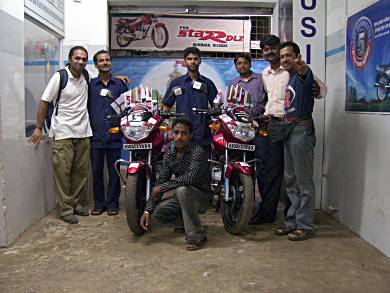
Now our bikes really look fantastic and like expedition motorcycles. All decked up and ready to move.
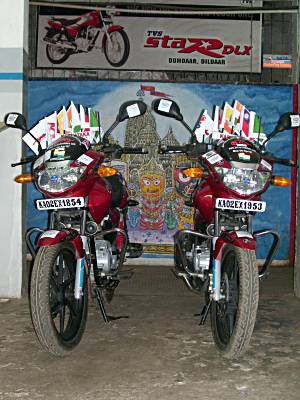
Our plan is to move to Puri via Bhubaneshwar and Konark and halt for the night at Puri tomorrow. Some press people we met this morning have promised to visit us tomorrow early morning and interview us for their publications. Let us see how many keep up their word. Right now it is 1:10 am and I am trying to update the site."

Heat-Troller
The authentic solid state DC power controller, designed and made in the US. Heated Liner Jackets and Gloves!
Keep yourself warm, save money and support HU at the same time!
Log in for a 20% discount on your electric vest / waistcoat (and Horizons Unlimited gets an affiliate fee).
|
Hubert Kriegel, France, on a timeout in New York state,
"The father of Lorraine (Jessica's mom) passed away. I flew yesterday from Lima Peru to San Francisco, California where i spent the day with my nephew Wilson then I took a train to Redding where i am helping Lorraine to move her stuff from here to Rochester where she lives. In Lima, Ivan arranged that I could park my sidecar in the garage of his friend Nicolas. I will go back to Lima in August to continue my travelling in South America.
I still have 3 or 4 stories on Machu Picchu that i am doing to put on my web site in the next few days.
 
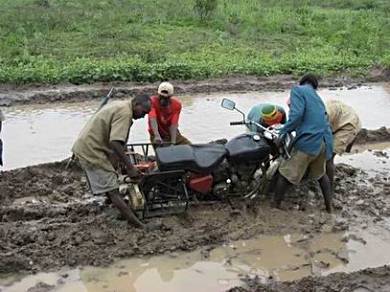
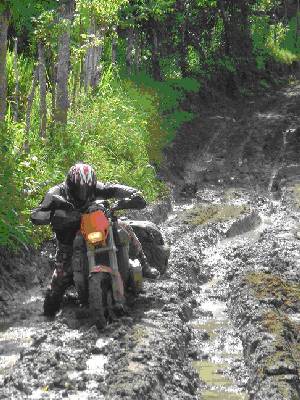
On a muddy road in Panama!
 
sleeping on the frozen lake Champlain
Ross Davidson, Canada, South American Adventure, in Brasil, BMW 650 Dakar,
"Our ride to Conquista the next day was interrupted by a total closure of a main highway by a landslide. We learned of a detour for motorcycles only that would save about 100km. At the entrance a cowboy on horseback confirmed the route and we embarked on a hilly 40km off-road trail through cow pastures and gravel roads that added a little adventure to the day.

It was with mixed feelings that I left Vassouras and rode towards Rio. I had decided my trip was coming to an end. After over 3 months on the road and 18,500km I was starting to feel a little too detached from my family and home. I still loved the adventure of starting the motorcycle each morning and heading down the road toward the new and unexpected. However, in my next destination, Southern Argentina (Patagonia) it was now almost winter with the risk of snow and freezing temperatures. Also, spring had arrived to my home and garden in Canada – who would do the chores? Finally, Brasil had been such a huge experience that my senses were pretty much overloaded and in need of a rest. I rode straight to the Air Cargo terminal at Rio airport and put my motorcycle on a flight to New York.

Luckily, I had a friend with relatives in Rio de Janeiro. What an amazing city! The geography alone is striking enough with the spectacular combination of mountains, ocean, lagoons and beaches. Add all the pastel colours (why don't Canadian buildings come in different colours?), heavily treed and clean streets full of people typical of Brasil and it is almost overwhelming."
Freddy invites you to stay at the "Pueblo Viejo" in the heart of Ushuaia, at the end of the world! Pueblo Viejo is just a few steps from the main avenue, Museums and places of interest.

Plenty of safe motorcycle parking, free internet access and WIFI and Breakfast included too!
"At the Horizons Unlimited Travellers' Meeting in North Carolina I ended up doing around three hours of presentation plus loads of QandA, and still haven't got my voice back properly. The Old Dear did her bit as well acting as a model example of how to set up the bike's ergonomics properly.
I spent the previous three days with Phil the Boxerman at Charlie's farm in Virginia, in the Appalachians close to the Tennessee border. What a nice chap, and such a treat eating proper food from the garden and steak from his own cattle. Not to mention just sitting on the porch beside a mound of cats and kittens, watching the woodpeckers and humming birds.
The it was a swift dash across the state to the Airheads' Gathering of the Clans, where Phil did a proper job on my rear main oil seal as a tech session, beautifully sited in the campsite bar (which also means I owe him another case of Paddy's).
Now I'm back at Stan's place in Florida, doing the shipping paperwork and other mundane stuff like sending parcels home - don't think I'll be needing the winter kit for a while, really. The RAC are FedExing my Carnet, spare parts for 'stock' should arrive today, Amazon are sending the Lonely Planet for South Africa together with the complete Blackadder as a thank-you to Stan. Then as soon as all that's sorted it's off to Atlanta to be crated again (hopefully the last time) and to do battle with impenetrable airline baggage rules."
  
Thanks! Grant and Susan
Derek Fairless, ATW Adventure Travel, in Halifax, BMW F650 Funduro,
"Mind you, the taxi driver did say that as it was the first week of the holidays, the streets were very quiet, just as well for I have been studying the traffic at the cross road junction where Hollis meets Morris, (sounds like a play). Ok, so if you are not European then this will be of no surprise to you, but some traffic ignores the red stop light, some don't. Pedestrians are still crossing when the green light shows. A car draws up to the traffic lights, stops, decides he doesn't want to go that way anymore and makes a u-turn to go back the way he came. All of this in a polite, well ordered and considerate manner. I think I get the hang of it. Pedestrians have right of way, always. They do in Britain, but everyone ignores it and the pedestrians jaywalk anyway. You may turn right, even with a red light showing, provided that your exit is clear and you yield right of way to cars from the left (who have a green light anyway.) That clear? No! I spend a couple of hours doing the Ontario Drivers Test online, and finally get the idea, they are a bit like a traffic light controlled roundabout, but not quite. Hmm not much use is it, I will just have to map my way out of town by the straightest route with the fewest turns, and once I get on the country roads I will absorb it all by example, a little at a time."
"The last few days have been spent in the lush green of Slovenia, a gorgeous part of the world where everyone is friendly and the bikers wave (hoorah), all a little bit Northern Exposure.
Now in Croatia and planning a route through the former Yugoslav republics... sorry for lack of photos, internet cafe not too well equipped!
Any ideas about ticks gratefully received as IM picked one up in her armpit (!) after a beautiful camping spot in the woods (did see fireflies though, so maybe it was all worth it!)"
Chuck, USA, Quastdog's World Beer Tour, in Bolivia,
"In 2005, for a number of reasons, I decided to take a chance and throw
caution and a comfortable life away and see the world by motorcycle. I
figured I could pull together the resources for 4 or 5 years traveling
the world on two wheels. If things go according to plan, I should be
finishing my travels sometime in 2010, about the time I turn 60 years
old...

...The rural population is abandoning the country, and flocking to the cities here in Bolivia. Most of the people are engaged in an informal economy - there are more street vendors in La Paz than anywhere else I've been. They set up everyday around the hotel I'm at - after all, I'm in the center of the city, near all the major commercial high-rises, 5 star hotels, and the tourist area. So every morning, the people come down from their shanty towns around the edges of La Paz. set up their little stands, and spend about 12 hours sitting there in the cold trying to make a bit of money for putting food on the table. They are selling anything and everything in these stalls. You'd be surprised at what you see being sold on the street. A few blocks from my hotel, there's a corner where the 'witches' have their stores. You can tell them by the desiccated baby vicunas and llamas hanging outside. What you use them for, I'm afraid to ask. 'Don't mess with the witches' is my motto.

I have trouble getting up in the morning because of the cold. There's no where to go until around 8:30 when the restaurants start opening up. Taking a shower in the morning is difficult. Few hotels have hot water - the shower I use has a small electric shower head (there's two sizes of heads, with different wattage - I much prefer the bigger wattage heads). If too much water flows through the head, the water is cold. Of course, early in the morning, you are standing naked in a room that is the temperature of the outside air, trying to adjust the water flow to where the shower head can heat up the water to lukewarm so you can take a quick shower.
As a consequence, I usually take a shower in the afternoon, where the outside air is somewhere in the 50's. So yesterday I'm taking a shower. I get the water thing going standing outside the shower while undressing. I get inside, but no sooner do I get wet and start lathering up, I hit the faucet handle with my elbow, which caused too much water to flow, so it got cold. I had to turn it off, turn it back on (so it would reset and heat up again) - did this a couple times - as soon as I got warm water again, someone turned on water somewhere else in the hostel, the pressure dropped, flow decreased through the heating element, and it went cold again. I stood there wet, in the cold for over a minute - seemed like several minutes - trying to get the water back on warm so I could finish my shower and get the hell out of there."
Book special just for Horizons Unlimited Readers!
"Into the den of the Bear and the Lair of the Dragon on a Motorcycle"
"8 Around the Americas on a Motorcycle"
"Africa Against the Clock on a Motorcycle"
"From Nordkapp to Cape York on a Motorcycle"
Werner Bausenhart has written several books on his travels around the world, and has offered them to HU readers at a great price. Tell him we sent you and get US$5.00 off the regular US$20 price!
For details on his books see here. Contact Werner now via this link to get the deal. |
"The Makgadikgadi Pans - Botswana - This is a trip offered by the Adventure Riding company - Kwa Nokeng in Botswana.
The same group I went to the Tuli Block with, a few months ago. If you get the chance - go stay at their lodge at Martin's Drift, and ride with Clinton, drink with Chemmy - you won't regret it!
I believe "Makgadikgadi" means something like place of changing water (wet / dry) in Tswana. ...The Makgadikgadi pans are the size of Ireland (10,000kms2) - and are dry at this time of year. It becomes an inland lake during the wet season - complete with a huge range of bird life.
Pretty uneventful transport ride (how the ambo got lost for a while puzzled us all!) - about 4 hours, but really pretty with the sunrise in what is really semi desert country. Arrived at Lethakane and everyone got suited up in their dirt riding gear, cars and trailers securely parked, fueled up all bikes, and we were off. From my previous experience - I knew it would get hot (particularly pushing the big pigs in sand) - so I wore well vented off road gear (full body armour and motorcross shirt and pants). Other were wearing full enduro jackets etc - and they did really get hot later in the day.
A mix of 1150's and 1200 BMW GS's, one 650 BMW Dakar, and a sole 950 KTM made up the group - 13 in all. Some nice dirt roads / tracks followed, and about 8kms of thick sand track to the pans. The sand sorted the noobs out - and when we got to the pans - only 3 riders had not had a "lie down" - some several.

...After lunch, some were lulled into a sense of complacency - but the twisty sand and ever present thorn bushes soon blew that complacency away. Why is every bush in Botswana a thorn bush? - and some with motorcycle rider radar - as they jump out, you launch into them (as one rider did over the handlebars - no not me!) - its like a strong magnetic field - you can't resist! I did have one little slip across the middle monakee (The middle monakee is the ridge between tracks [spoors] when the track is in sand and made by 4 x 4's). - and a brief lie down!
Kept the engine running and tried to remount before the next rider caught me in such a compromising position! Too late - he rounded the corner just as I was remounting - damn - I would have to admit to an off!
This admission raised cheers from the group later. This left only 1 person who did not have an off or who was caught!)

I then stopped trying to avoid the thorn bushes too near on inside corners - and just ploughed past them. Needless to say - I now have countless scratches on either side of the bike (mirrors, tank, screen) as a "badge of courage" for the windy sandy tracks in Botswana! Surprising though - no scratches on my arms - or even clothes, but I have to say, I learned that trying to avoid the bushes on corners was often more hazardous - crossing the middle monakee has caused many a rider to fall..."
Motoqueros -
Mit dem Motorrad durch Lateinamerika
by Arno Backes, in German only, €14.95 plus shipping and packing |
"Motoqueros - Mit dem Motorrad durch Lateinamerika
"Written by Arno, with contributions from Sian and others, this book is in German, and follows our 18 month trip of 55,000kms, from the beaches of California to the most southerly city in the world. As we ride down Central America, past Mayan ruins and steaming volcanoes, read how we then cross into South America, battle through the endless Pampa in Patagonia, along the Altiplano to the heart of the Inca kingdom, ending after 18 months in the city of tango.
At almost 340 pages and with over 150 photos, both colour and black and white, the book really gives you a feeling of participating with this journey, even if you can't read German! Some photos have been used previously in Sian's blogs, but most are brand new."
Order details.
|
Kevin and Clara McCrea, USA and Colombia, RTW, in Brasil, BMW R1200GS and BMW 650GS,
"We passed the meridian yesterday stopping for a photo. The first time our bikes had been north of the equator in many months. It was a day of firsts. First sloth we saw on the road, first time we saw five people on a 125 motorcycle (twice!), and in Boa Vista first time I saw a woman walking around naked from the waist down in public.
The highway was so bad with potholes that they dislodged by backpack and handlebars. My bars kept getting closer and closer to the ground until I finally had to start humming the War song "lowrider" to myself and hoping the bars wouldn't loosen to the point of flapping freely. I would have fixed them but the mounting bolts are a reverse six sided star bolt, the only ones on the bike and I knew I didn't have the socket. An extremely friendly crew at the honda shop not only straightened me out, but found us a discounted hotel as well!"
Andi Naumann, Free Solo 2007, Germany to India, in Israel, MZ ETZ 251 Saxon Tour
"I managed to get myself and the bike to Israel. I was so happy and still couldn't believe it worked. Seeing road signs to Jerusalem just felt unreal. The crossing involved getting an exception for riding the bike over the Sheik Hussein Bridge (usually forbidden), surviving the very, very sincere security check of the Israelis (they feared my second battery is a bomb!), avoiding both Jordanian and Israeli stamp in my passport (otherwise the return travel through Syria would be rendered impossible) and flirting with the cute chicks at the Israeli passport control. I'm telling you, it was hard work :-) ! And more of this kind was to come.

Jerusalem! This city has so much history, it's very, very fascinating to see and feel some of it. On the other hand it's also frightening that the ever prevalent conflicts are still going on. I didn't know what I should feel in this town. Since I'm a fairly unreligious person, the significance of all the churches, mosques, synagogues and all the other sacred places are not that vivid to me. So when I came to Jesus (supposed) tomb and listened into myself what I felt (as advised by Gabriel, the romanian monk) all I could find was that I'd probably be travelling for some time longer.

A more spiritual experience came later at night. As I lay on the roof of my hostel with a view all over the city, looking at the stars - I found mine I think."
Erik Saue, Around the World, in Australia,
I was thrown onto dry land at the east end of the Great Ocean Disappointment with a diluted faith in ever finding the one thing in Oz that would surprise the hell out of me. After all there was nothing left but the dreary coastal highway to Sydney. That's when it happened; the Oh-I'm-bored-center in my brain made a coup d'état of my body, and I helplessly watched myself do a left turn in a crossing with no signpost. The road went up in the Snowy Mountains, and after two days and a very cold night I arrived in a place so seldom seen that it is called just that - Seldom Seen.

Seldom Seen was not much, just a very remote petrol pump run by the David Woodburn and an emu. In 2003 it became even less when a bush fire roared through the area, too far away for any fire truck to assist. David barely saved his life by sitting in a dam with a kangaroo. He lost everything including his roadhouse and emu friend.

But nowadays he has a new buddy, the sheep Lamborghini, a new petrol pump, and two camper vans where they spend their days making art of rubbish. David seemed happy to see me (ref: see somebody), fired up the coffee kettle, and we sat for hours in a pile of debris talking about this and that and then some more. It was all very weird and wonderful."
Gonçalo Mata, Portugal, Buenos Aires to New York via Ushuaia, writes to the HU Community in New Jersey,
"Hello! My name is Gonçalo Mata, I'm Portuguese, and 6 months ago I left Buenos Aires alone with my motorbike.
Now after nearly 40.000km I'm about to arrive at my final destination: NEW YORK CITY. I don't know anybody there, and I thought I could ask if someone would like to help me!
I would like to gather a little group of riders that can lead me from Newark to Central Park, so I arrive safely, and also not so lonely! I think it could be a nice summer ride, it will be a saturday, 18th August.
Do you know some motorbike rider in New York, or a club or just someone that cares to ride with me on this final moment of my big trip? Here is the plan with all its pending variables awaiting for nice suggestions from locals:
DATE - Saturday, 18th August
MEETING POINT: 14h30(?), in Newark - where exactly(?) airport,maybe(?)
15h00/15h10 - 16h30/17h00: the ride, maybe including a micro NY tour before reaching Central Park - exactly what entrance(?) what itinerary(?)
17h00 - maybe a cold beer to celebrate? where could that be(?)
Thank you so much for any possible help/tips.
Gonçalo Mata"
From John his webmaster: "Frank is still in Cotonou, Benin, grappling with the problem of how to get round or through Nigeria. Its not easy to get transport direct to Gabon across the sea, but it's also very difficult to get a visa to cross Nigeria, quite apart from the murder rate there. So he is having a ponder about the next move, dogged by voodoo queens but encouraged by a little chair-making with cheery local carpenters, (logs to chairs in three days)."
Mike Skinner , Scotland, Argentina to Alaska, in Canada, writes to the HU Dawson Creek Community,
"Hi, my girlfriend and I are on a 10 month tour from Argentina to Alaska, currently in Calgary, Canada. We'll be setting off for Banff, Lake Louise and Jasper tomorrow (monday 9th July), then heading towards Whitehorse and finally Alaska.
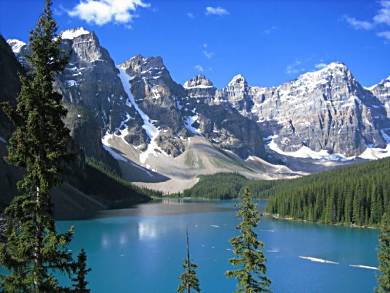
Lake Moraine, Alberta
Does anybody have any good recommendations for cheap camping or a place to pitch a tent for a night? Many thanks, Mike"
Leaving soon, or just left...
"Hi folks - we are in Silverton Colorado at the Horizon's Unlimited Meeting - 7 days from Sedro Woolley in Northern Washington where we officially started heading south (sort of.)
We left Revelstoke in the rain, got a flat tire in Kamloops! (which Thom helped us
fix) and rode through rain and sun and cold to Hope. Spent a great weekend with friends at a wedding and then headed to Sedro Woolley - spent July 4th with friends and picked up a softer seat!
Can you say "heat wave"? The next 6 days averaged
100-115 degrees Fahrenheit! North eastern washington, the cascades, south past Coulee City and then then up top wild camping in Idaho at 7500 feet to try and be cool overnight. Then we gave up and booked a $22 room in Wendover at a casino - yeah! air conditioning!
Then to the coolest camping place in Utah - Green River for 2 nights and we managed to spend one day "in" the Green River cooling off. In the meantime a few hikes in the canyon areas... more wild camping just over the border in Colorado and then it got very cold and rainy- a relief, sort of. So here we are...
still working out the day to day travelling routine ... staying hydrated...
and finally catching up with internet stuff free at the Silverton Library.
The flat tire we got in Kamloops has finally given up the ghost and we are having a new one delivered this afternoon.
Expect to be in Mexico by the 18th ...end of next week."
Ekke and Audrey Kok, Canada, RTW, laid up in Germany, R100GS and F650,
"We flew to Munich on July 5 with a plan to head up to Nordkapp and then down to South Africa via Eastern Europe and Syria, Jordan, Egypt. Unfortunately it all went a bit sideways when we picked the bikes up at the cargo terminal in Munich (using Motorcycle Express as advertised on HU worked a treat!). I was rolling my bike out when a Swissport Cargo person, who was looking for the keys to the bikes that they had misplaced, wanted to see what the key fob looked like. I balanced the bike and reached for my spare key when the bike tipped over towards me. I tried to catch it but it went over with the tank landing on my knee, rupturing the patellar ligament. I'm now laid up in Bavaria looking at three months of recuperation before I'll be strong enough to ride the R100GS through Africa. Another piece of bad luck happened when Audrey came to visit me in the hospital in Freising one day. When she went out to her bike the Alberta licence plate had been stolen! Fortunately we had authorised someone back home to get her renewal so she didn't have to go back to Alberta to get a new plate. Of course now our Carnet de Passages needs to be changed too..."
Maria Sanchez and Alistair, France and UK, to South America, in Colombia,
F650GS and 1200GS,
"In 2004 we went on holiday to Peru. In a hotel lobby in Puno,on the edge of the lake Titicaca, we saw a motorbike. The number plate was British. Someone travelling by bike around South America! We never met the biker. By the time we came back from visiting the floating Islands, the bike was gone. I never completely forgot that bike, I was already thinking of the possibility of doing South America by bike. I was not the only one having crazy ideas then... It kept me thinking.
One day, coming back from work, I said casually to Alistair, who was busy reading the sport pages of the Evening Standard: "What about taking the bikes with us to South America?" I expected he would tell me I was mad, and I had prepared a long list of reasons for why we should take the bikes. I needed not to worry. His reply was only "Yeah, why not..." before plunging back to the footy pages! (Note to myself: always propose crazy ideas to other half when he's reading good news from the Footy pages of the paper!)

On the subject of animals we've now heard a few stories from fellow bikers on that front. On the first day in Bogota we met Jason who had hit a horse in Argentina. The horse must have been a bit surprised as well as it crapped all over him and his bike. He had to ride the rest of the day with the whiff of horse manure hanging over him! He wasn't happy, but I imagine the horse wasn't too pleased either. I thought that I was going to suffer a similar fate the other day when following a pick-up truck. The farmer had packed the animals in so tightly that one pig's bottom was hanging over the tailgate. I was staring down the barrel of a gun and if he'd let fly then I'd have been covered in the smelly stuff. Another rider told us a story of a group of bikers in Alaska who were chased by a pack of wolves (apparently they think that the bikes resemble caribou). One got bitten on the leg before the wolves realised they'd made a mistake."
"Who am I but you?
All souls are one...and lonely.
Surely I have learned this in the last year.
But in this special place everything moves with just a little more peace and tranquility than is normally felt.
There are no guns and violence is accidental.
Things feel more circular.
Well, everyone lives in a round house.
Horses outnumber cars...and there is space."
Colin and Robyn Young, Australia, in Europe, writes to the HU Paris Community,
"My wife and I are in Avallon; We are from Australia and we would like to meet anyone to go for a ride; We are in France till 25 August and then going to Italy for September. We have very little French unfortunately, we are learning a bit each day. We bought a GS1200 in Germany; We are both 53 and this is our first time in Europe; Regards Colin and Robyn"
Kang Se Whan, Korea, in Mongolia, writes to the HU Ulaan Baatar Community,
"Hi, I'm in Ulan bataar now and
staying at Goodmorning hotel.
It's 10 minute by car from Chinggeiskan hotel in downtown.
I'm from Korea with Suzuki DR650 and I cross border from Ulan Ude then come here.
I will stay here until next week,so
I'd like to meet Mongolian bikers!
Please email me or let me know your cell phone number then I will call you.
Thanks.
Se whan, Kang"
Into Africa
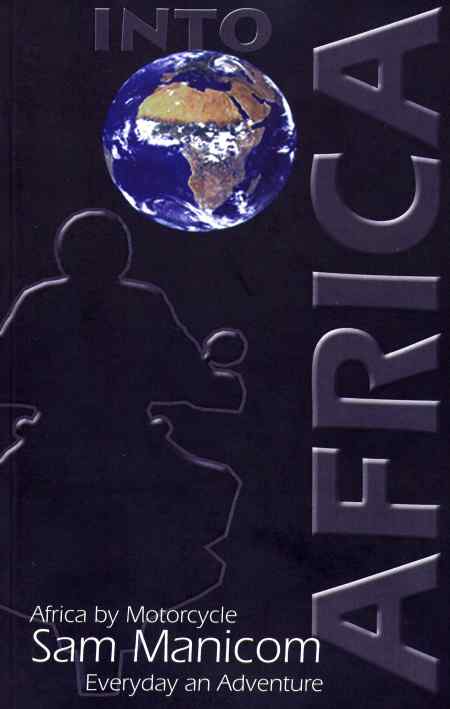
by Sam Manicom |
This is a story of amazing Africa, it's people and some very good reasons why not to fall off a motorcycle.
Riding across fourteen countries from the island of Jersey to Cape Town, this eye opening tale catapults you into Africa.
Sam's plans frequently don't work out as they should, and every twist in the road leads him to new challenges and surprises. The journey throws disaster in his way, seeing him jailed in Tanzania and hit by a serious wipeout in Namibia. He lives in a remote village, canoes a dug out in Malawi, escapes a bush fire, climbs a mountain and much more.
He says, "Traveling on two wheels is the perfect way to explore a continent like this; it's all about freedom and the ability to take advantage of opportunity."
A special shine is given to this adventure by the warmth and welcoming nature of Africa's people; Sam's love of Africa glows from this book.
Available from www.sam-manicom.com
Price: £13.50 – 10% off when ordered quoting Horizons Unlimited
HU discount price: £12.15 + UK PandP = total £14.15
+ EU PandP = total £15.15 (= € 22)
+ US PandP = total £17.15 (= $ 31)
|
Home again (temporarily) ...
Jeremiah St. Ours, USA, to South America, home again in Colorado, BMW F650GS,
"For those of you living in or near Durango, Colorado, I intend to hold a multi-media presentation and story-telling event entitled: Jeremiah's Journey, a Pan-American Odyssey. The exact date and location will be advertised here on the web site, as well as in the local newspaper and on radio. My target is sometime this fall, but it will require so much preparation, the date might slip to winter or even spring of 2008. I hope to secure one of the local theaters so that a maximum number of folks can attend...

El Viento gets the work over in my garage
In other news, Columnist John Peel of the Durango Herald recently interviewed me for his regular newspaper column. It appeared in the paper on Monday, June 18th, and is entitled "Living the dream: Traveler talks about spanning Americas." Click here to read the article online. There's also a link to the longer, audio version of the interview within the text of the online article.
Thanks to everyone who has communicated with me via email during the trip and this first couple of weeks back home. Your kind words of encouragement are appreciated more than you know."
Mark and Erin Kirkendall, USA, RTW?, thoughts from back home, BMW F650GS,
"Pulling up in front of our little white house, it's a quiet arrival. In my head, there's a parade with confetti and a marching band. We've ridden the bikes over 30,000 miles on four different continents and 25 countries. But that's not what my imagined celebration is about. We did it completely unscathed. Other than a couple of days of fever with my infected shot in Buenos Aires, my nagging herniated disks and Erin's hemorrhoids, we've had no illnesses or injuries. A few petty crimes: pick-pocketing, crooked cop and stolen riding pants. The celebration is about surviving the physical part of the journey and all the growth that's happened along the way. Our relationship hasn't just survived, it's actually thrived under all those hard days of riding, cockroach motels and uncomfortable moments. Erin's a different person, much more confident and assertive than she was on the start of the trip. I'm different too, much more open minded, more comfortable, yet a lot more humble.

Lot's of things to do in the upcoming weeks and months. One is I'm going to be putting together a talk to share at a couple of Horizons Unlimited meetings and hopefully motorcycles dealers to follow. It will have some of the highlights of the trip as well as lessons we learned along the road. But my first and loudest piece of advice or counsel for anyone thinking about a trip like this is very simple. Just go. Whatever bike you have, with whatever budget of time and money you can afford, just go. Pick the absolute shortest route between now and your departure. The world is not what you see on TV. Countries don't consist of governments you hear about on the news, they are made up of people. And those people are a lot more friendly, a lot more welcoming than you can imagine. And while I think there's no better way to see those places and meet those people than on a motorcycle, you should go by whatever means of travel you want. So just go. ‘Just Do it”
Deb and David Welton, RTW, back in North America, planning the next leg, F650s,
"The short day's ride to Christchurch signaled the end of this part of our trip. We arranged for crating and shipping of Deb's bike and decided to sell Dave's bike. We did some riding two-up in while in New Zealand and found the bike big enough for both of us, so we decided that it made sense to sell one here rather that paying to ship it home.
So, here we are back in North America visiting family and friends. Deb's bike is somewhere on the Pacific Ocean expected to arrive in about one month. This summer we will decide where to ride to avoid the cold weather next winter and hopefully we can make it to another Horizon's Unlimited Travelers meeting this year."
Jack and Janet Murray, USA, China to Europe and North America, in North America, BMW R850R with sidecar,
"It is difficult to try to explain to non riders and many riders alike, the allure of long distance motorcycle travel. So often we are asked, 'Why don't you travel in a car or an RV'? I thought I knew the experience after having ridden through the American west for several two week trips but the simple fact is that only now, after months and months on the road, am I finally starting to really understand it.
Riding on a motorcycle is visceral. On a bike you experience everything: the heat and cold, the rain and humidity, gentle breezes and howling winds, the dryness of the desert, the smell of crops growing in the fields and freshly cut grass, manure and flowers. One becomes more intimately aware of the road; hills, turns, bumps and potholes. The immediate environment takes on a new reality, a continually changing perspective. Everything becomes more real. You can almost taste the difference between one country and one culture from the last. You are exposed to all of this and more, all at the same time which makes for a more complete experience.

...Brown's in Seabrook, NH was an old haunt for Janet and I when we were first married and living in Hampton, NH. We used to take the boat down the Hampton River and cross Hampton Harbor to the Seabrook side and follow the marsh to Brown's. I would hold the boat while Janet would run in and get a couple of lobsters and some steamed clams. Then we would anchor in the river near the bridge and pig out on our purchase. Returning to Brown's now was almost like going home.
We had intended to get just the steamers but once there, I couldn't resist. First, I ordered fried clams, just enough for a taste you know. Then we ordered a big lobster and the steamers. Heaven, I don't think there is a better place for lobster and clams in the world except my house when I cook them."
Brian Coles, UK,and Fie, back home after travelling in Laos, Cambodia and Vietnam,
" Hurrah! We made it home without any broken bones. It has to be said that it definitely comes as a relief to me. In the last month especially I was desperate not to have any kind of arse meeting road incident. I was in free fall mode, I wanted everything to be easy for us for the final bit, to hell with it - "let's go crazy, let's go mad, let's spend more than 4 quid on a nights accommodation".
We had definitely had enough of rubbish roads by the eighth month of riding. We only had a couple of days dodgy riding in the last month. They were both in Laos. In fact our first major ride into Laos was pretty kak. The road in to Laos from the northernmost Thai - Laos border consisted of "bull dust" (imagine very fine saw dust ranging from 3 inches to a foot thick) that made it very hard to see exactly how big the rocks that your tyres are bouncing all over are, to freshly wetted mud (the roads are hard packed dirt and are regularly watered by an oversized watering can - in the shape of a large water sprinkler truck). After this first day of rubbish road we had tarmac.....ahhhh wonderful tarmac."
Colin and Dee Masters - Wrinklies Wround the World 2006-2007 – Home now!
"From Lemoge it was a leisurely ride to St malo where we got the return ticket to Poole even cheaper than UK prices. First call was, of course, to see Doug ( our son).
Riding in France and Spain is so easy - very little traffic and the worst thing is trying to find an IT cafe ! All the hotels (and a lot of the cafes) - are geared up for wireless - so, if you have a laptop, you are laughing.
I still find that some of the IT cafes will not accept the camera - and that is a pain! or it's me being dense.
So now we are safely back home and talking about the next trip - which, we think will be to Scotland! - in September. It will be totally different packing- wise as we will not have to take mossie nets, spare books, electric adaptors, Lonely planets etc etc.- all that spare space, we won't know what to do with it all! All for now-until the next journey!"
 Traveller's Community News... Traveller's Community News...
New Communities:
We've now reached an amazing 462 Communities in 90 Countries as of May 17, 2007!
A big thanks to all those who took the first step and established the Community
in their area. New Communities are too many to list - it has been a while!
If you are on the road, do check out the Communities - don't feel
like you're imposing on people! They signed up for a Community because they
want to meet travellers - that's you! You'll have a great time, so
go to the Communities
page and let them know you're coming. Please remember that they are volunteers
and offering to help because they're great people - common courtesy helps!
When you write, tell them who you are, that you're passing through, and would
like to meet them. Let them know if you need anything, and I'm sure they'll
help as best they can.
For details on how you can join a Community in your area, or use the Communities
to get information and help, or just meet people on the road or at home, go
to the Community
page. Send me some photos - with captions please - and a little text and you
can have a web page about your Community! A few links to web pages
about your area would be useful too.
Just a reminder to all, when you Join a Community in your area, send
a note to the Community introducing yourself and suggesting a meeting, or
go for a ride or something. It's a good way of meeting like-minded individuals
in your own town.
More ways to support your favourite website!
How to Link to Horizons
Unlimited
Contributions
To help with the cost of creating and distributing the newsletter and running a huge website, we gratefully accept contributions
via PayPal, credit card, Amazon, and Letter Mail. For more information on donations:
Support this Newsletter by Donating Today,
by PayPal, credit card, Amazon, or cheque.
If you want a t-shirt or other logoed merchandise, go to the Store.
Also, you can just click on any Amazon link on the site and we'll get a small commission on
your purchase of any Amazon merchandise - and it won't cost you any more!
All contributions will be acknowledged and gratefully accepted. If you later decide you do want an item from the store, let us
know and we will arrange it.
Thanks, Grant and Susan |