How to Ship Your Bike
Introduction
This section contains:
Enter YOUR OWN PREVIOUS shipment, to help other travellers!
Actual Shipments DONE by Travellers
See the Shipping pages for information on air and sea shipments by actual travellers to or from everywhere!
For each shipment, the details include Shipping wooDate, Cost, Shipper Contact details and a Description of the experience, in many cases very detailed and extremely useful information about the requirements for crating or the paperwork involved at the destination location.
This information has been gleaned from various sources, and not all details are available for every route. If you are aware of any more up-to-date information, or you know of any shipping details for locations which aren't listed in the database, please advise us. Thanks to all who have entered shipment details, and please keep it coming!
Air or Sea?
After shipping our own bike many times, and watching and hearing about hundreds more shipments, we have come to the conclusion that overall, the best method to send your bike is via air.
Sea shipping sounds cheaper, but the port fees are much higher, often off-setting any savings, or worse, as we heard recently, costing a traveller more than the entire original shipping fees! And by the time you factor in being without the bike for weeks or even months, it's usually not worth any savings you may get in the end. An important thing to watch for is that sea shipments are extraordinarily unreliable for time. The shipper will often quote for instance 6-8 weeks to ship from Vancouver to Europe by sea. Experience has shown that this is at best an optimistic guess, at worst a flat lie. Yes it can be done in six weeks, but not if the boat is rerouted to Nigeria! Twelve weeks is not unheard of, and then there's the dock strikes...
We know of one traveller who arranged shipping for her bike from England to Ecuador 12 weeks in advance of her planned vacation in South America. On arrival in Ecuador, she went to the shipping company's office looking for her bike. They knew nothing about it. It was still in the UK, awaiting a boat. She didn't enjoy the bus for the next two months. At least with an airplane they can always put it on another flight and it will only be a matter of days before it arrives.
Unfortunately US airlines are paranoid about shipping bikes - they class them as "dangerous goods" - and often refuse to carry them at all. All you can do is call all the airlines freight departments and find out if they will do it. Not the head office etc. - their automatic reaction is NO. If you find one make sure you talk to the guys in the freight department that actually handle it - what they will tell you is often very different from the official story from head office and passenger people. Do a search using the search bar above on "dangerous goods" to find much more about solutions and ways to deal with the problem. MOST shipments aren't done out of the USA anymore, most travellers use Canada instead due to this problem. Air Canada is very familiar with shipping bikes, and it can generally be done by dealing direct with the FREIGHT guys at the airport - not the check-in desk! :) Air Canada also regularly does super deals on shipping, in the range of half or less the usual, during the northern summer. See posts on the HUBB Trip Transport Forum documenting the details.
Lufthansa and other European airlines, as well as South American and Asian airlines will generally take a bike. You may have to work through an agent, but it is usually not too expensive for their services, and they will take care of all the paperwork for you.
For a good description of the crating process, see Chris and Erin Ratay's website. Chris also made this comment on the Air vs Sea question on the HUBB:
"Receiving a bike at the airport in Buenos Aires is much cheaper than at the seaport. ($60 vs $400). I've heard that Uruguay is a bit more expensive.
A friend shipped his bike to Valpariso (near Santiago), Chile, and paid US$7 -- yes, only SEVEN Dollars to reclaim his bike. I was with him, and the whole process was done in one day. The customs offices are walking distance from where the containers get unpacked."
Also, there are numerous more posts on the HUBB on this topic, in the Trip Transport forum.
General Instructions for Shipping
- You may get told you can't ship the battery with the bike - that is not generally true - you MUST however completely disconnect the battery and tape the terminals securely. Also usually you must drain MOST of the fuel out of the tank, a litre or pint or so left is usually fine, just enough to get you to a fuel station on arrival.

Grant preparing to crate the bike in Cape Town, South Africa
- We usually leave the front wheel on when shipping as we're lazy - it can be an advantage to be able to just wheel the bike out of the crate and drive away, particularly in places like Nairobi. All I usually do is take off the mirrors and windshield, but it does cost a little more. Sometimes the local warehouse where you pick up the bike will not allow you to dismantle the crate there, insisting you take the crate away on a truck. We've always been able to get around this, but it has taken some persuading in the USA. (and waiting for everyone to go on coffee break)
- Crates can often be obtained from a dealer. Wood crates are the easiest to deal with but many crates are now metal with a cardboard wrapper. They will work, but are harder to custom size. They are lighter, which can be good, but usually the problem with a bike is not the weight but the volume.
- Shipping costs are calculated on a weight per volume basis.
If the weight is over x / cubic foot then you pay the weight, if under
you pay based on volume. Bikes are bulky, and you have to work hard to
get the volume down in order to pay the weight price. You will have to
really squeeze hard to get down to the weight price.
"Size counts" formula in common use:
Length x Width x Height in cm. divided by 6 = weight in KG.
e.g. 225 x 100 x 115 = 2587.5 cm3 divided by 6 = 431kg
Therefore regardless of the REAL weight of the bike and crate, you will be charged AS IF it weighed 431 KG.

Strapped down on the base of the crate
- DON'T fully compress the forks. The bike should be tied TIGHT down on its suspension, about half-way or a little more down. Be SURE the straps can't loosen or come unhooked if the bike moves, because it will!
- It should NOT be resting on centre-stand or side-stand, only on its wheels, and vertical. This will not harm the springs (unless you leave it for a couple of years). If it's on the stand, it will pound up and down in transport, and cause a lot of damage to the stand, the crate, etc., as well as loosen the straps!
- Use good straps (I like 6) and don't skimp on the crate. You can usually get them for nothing from bike dealers, since they usually throw them away anyway, or even have to pay to get them hauled away. Good straps are often available for free from BMW dealers - they are what BMW uses to ship their bikes, and dealers end up with plenty. They are popular though!
- IF you really want to squeeze the volume down, take the front wheel off, rest the bike on the forks (with axle installed and clamps tightened but NOT the end nut), and tie securely. I like to have the axle secured to the base of the crate.
- Book a container and put several bikes in it, and the cost per bike will usually drop significantly.
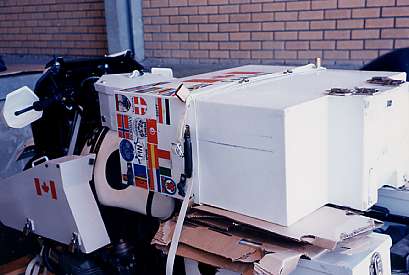
Strapping boxes on top, getting as much as possible in and as small as possible.
To reduce your shipping costs - from Istvan Szlany:
- Dismount front tire with fender, handle bar with mirrors, and side+tail bags/boxes to reduce height, length and width and you'll pay the minimum possible by volume.
- if you can, crate the bike, because then they can put other things on the top of the motorcycle crate. Ask around for scrap wood (*) see note below), nails and hammer - I'm sure they have. In this case you will pay most likely for the weight of the motorcycle.

Almost done.
For a good description of the crating process, see Chris and Erin Ratay's website.
Also, there are numerous posts on the HUBB on this topic, in the Trip Transport forum.
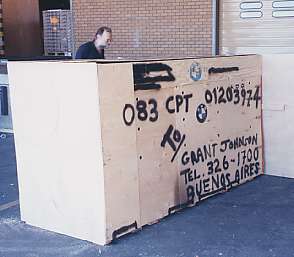
Make that address BIG! And on top, and the other side, and the end too!
Other issues to think about
- Import regulations
- Carnet de passage or temporary import permit (esp. OZ)
- Insurance (transport, bike, health insurance etc.)
- Quarantine: Be aware of very strict regulations for OZ and NZ.
- CLEAN - the bike must be SUPER CLEAN or toothbrush clean for some countries, especially Australia.
- * WOOD - Many countries require that all crates made out of wood be heat treated to reduce the risk of pest infestation. These crates require an approved stamp known as the "bug stamp" or ISPM 15 mark, certifying the crate meets international shipping standards. Do your wood crates pass the test? If they don't, foreign authorities have the right to fumigate or destroy your shipment without notification. NOTE the word "shipment" - that INCLUDES your motorcycle! They can also just send the shipment back, at your expense. More info on ISPM-15 here, and here on Wikipedia.
BEST PLACE TO ASK QUESTIONS IS ON THE HUBB IN THE TRIP TRANSPORT FORUM: CLICK HERE.

Global Rescue is the premier provider of medical, security and evacuation services worldwide and is the only company that will come to you, wherever you are, and evacuate you to your home hospital of choice.
Additionally, Global Rescue places no restrictions on country of citizenship - all nationalities are eligible to sign-up! Travel medical insurance is also available, currently the limit is 90 days. (TIP: For Evac insurance - Click Multiple Trips and 365 days to get year long insurance.)

Ripcord Rescue Travel Insurance™ combines into a single integrated program the best evacuation and rescue with the premier travel insurance coverages designed for adventurers.
Led by special operations veterans, Stanford Medicine affiliated physicians, paramedics and other travel experts, Ripcord is perfect for adventure seekers, climbers, skiers, sports enthusiasts, hunters, international travelers, humanitarian efforts, expeditions and more.
Ripcord travel protection is now available for ALL nationalities, and travel is covered on motorcycles of all sizes! NOTE: Travel medical insurance currently has a limit of 90 days.
Member login
Announcements
Thinking about traveling? Not sure about the whole thing? Watch the HU Achievable Dream Video Trailers and then get ALL the information you need to get inspired and learn how to travel anywhere in the world!
Have YOU ever wondered who has ridden around the world? We did too - and now here's the list of Circumnavigators!
Check it out now, and add your information if we didn't find you.
Are you an Overland Adventure Traveller?
Does the smell of spices wafting through the air make you think of Zanzibar, a cacophony of honking horns is Cairo, or a swirl of brilliantly patterned clothing Guatemala? Then this is the site for you!
Hosted by Grant and Susan Johnson, RTW 1987-1998
Next HU Events

HU Event and other updates on the HUBB Forum "Traveller's Advisories" thread.
ALL Dates subject to change.
2024:
- California: April 18-21
- Virginia: April 25-28
- Germany Summer: May 9-12
- Québec: May 17-19
- Bulgaria Mini: July 5-7
- CanWest: July 11-14
- Switzerland: August 15-18
- Romania: August 30-Sept 1
- Ecuador: August 24-25
- Austria: September 12-15
- France: September 20-22
- Queensland is back! Oct 4-7
- Germany Autumn: Oct 31-Nov.3
- South Africa: November
Add yourself to the Updates List for each event!
Questions about an event? Ask here
HU Achievable Dream is Online
and available now to stream on Vimeo!
ALL 15 chapters of the HU Achievable Dream Guide are available to download on Vimeo!

Binge watch over 18 hours of inspiring, informative and entertaining stories and tips from 150 travellers!
"a cross between entertaining stories, tech tips, and reference guide"
"A timeless introduction to Motorcycle Adventure Travel!"
Originally launched as a 7 DVD set, The Achievable Dream series can now be downloaded anywhere. OVER 18 hours of solid info take up zero space in your panniers. How convenient!
Books

All the best travel books and videos listed and often reviewed on HU's famous Books page. Check it out and get great travel books from all over the world.
NOTE: As an Amazon Affiliate we earn from qualifying purchases - thanks for your help supporting HU when you start from an HU Amazon link!
Comments
FYI
FROM AMC...
We are partnered with WestJet for their "Bike Air" program, transporting bikes via airfreight. However they are only offering European destinations and we would not have any options into South America for this.
Chris Fast, Freight Forwarder
AMC AIR MARINE CARGO
8063-22ND Street N.E, Calgary AB, T2E 7Z6
Tel: 403.250.9636 || Toll Free: 1.866.581.8122
E-mail: oper...@airmarinecargo.com || www.airmarinecargo.com
Westjet and Air Marine Cargo (AMC) have started a new program of their own for shipping your bike to and from Europe / Canada and points beyond for 2023!
Get all the details on this new bike shipping program here.
Hi, we are in appr. 20 days in Bogota and want to ship us to Panama. Overland Embassy doesn't reply. Does anybody know who to contact?
Rudy
There's quite a bit of information on the HUBB about shipping, especially on this route. See the Horizons Unlimited HUBB: https://www.HorizonsUnlimited.com/hubb and look at the South America, and Central America / Mexico forums, and of course Trip Transport forum.
Hope that helps!
Hi All
Can someone advice us (5 Bikers) about shipping our bikes (BMW 1200 GSs) from Daressalaam (Tanzania) to Cape Town (South Africa). Costs (Container), packing and paperwork. Thank you
I've never heard of that being done, generally people ride down. You'll have to do some research in Dar, see what you can find out.
Best of luck, and please let us know how you do.
I am immigrating to New Jersey USA from Bangalore India in a couple of months and want to take my beloved motorcycle Royal Enfield Bullet Standard 350, 2011 model with me.
Any help or information is greatly appreciable.
There's a LOT of info on the HUBB about importing foreign motorcycles into various countries. there are a LOT of issues! It is probalby not fully legal in the USA, and will need to be brought up to USA spec. Every state has it's own rules, so you will need to contact the Motor Vehicle office in the state you're moving to and asking them the rules.
Shipping - load it in the container with your household goods if you're talking a load. NO gas, battery disconnected, temrinals taped securely, and even then you may have problems, but work with your shipping company - "Dangerous Goods". Otherwise, Motofreight and James Cargo can help, see their ads on this page.
Good luck!
Any leads on companies that can air freight from Washington State to Chile or Peru?
DL650 VStrom, and want to leave Jan 02, 2022.
thx!!
We know of nothing specific, but check Motofreight and James Cargo, both are very good, and they both ship bikes from anywhere to anywhere.
I have found several companies to ship the bike from Miami to Le Havre at a resonable cost but they are quoting 3000 -4000 to ship it back from Europe.
Can anyone recommend how to get the bike back after a temporary export.
Perhaps Airfreight would be the best.
Hello everyone, is it possible to kinda hitchhike a ride on a ship or roro from canada to europe with the motorcycle and be traveling oversea with my bike ?
I wouldn't say IMpossible, but certainly EXTREMELY difficult / unlikely. In other words, don't plan on it. Best bet is Air Canada's super deal, though not this year with COVID.
Search the shipments and see what people are doing. I do know of ONE guy that got his bike on I think it was the Queen Mary passenger liner as "luggage" - but he also needed a proper dinner suit, and it was MUCH more expensive than flying your bike and you.
Hope that helps!
Hi there, can anyone offer some advice or had recent experience air shipping to Mexico? We are preparing to ship our bike with Motofrieght (great experience so far) from the UK to Monterrey or Mexico City. Also, any advice on permit requirements for the bike would be much appreciated, as the TIP (Tempory Import Permit) for Mexico only appears to be applicable to US/Canada foreign vehicles? Thank you!
RECENT experience, no one has that I know of. The last year has pretty much shut down shipping bikes anywhere.
Having said that, Motofreight will know as well as anyone. I'd be surprised if there were any changes on importing into Mexico recently. The TIP or equivalent should not be difficult to sort on arrival, but do check with Motofreight on their knowledge.
Mexico is NOT commonly shipped into, most people opting to ship into USA / Canada and ride south. Foreigners have no issues riding across, it's done frequently. I've never heard of any problems.
Hope that helps! And please be sure to post your experience into the Shipping database to help everyone, especially important when it's an unusual one like this. :)
Can anyone offer direct experience and recommendations for economical moto shippng from USA to Colombia? Air or ship. Hours of searching has not yielded anything recent. Small, crated dualsport moto. Miami to Cartegena would be ideal, but locations are flexible. Thanks! Steve
Steve, have you checked the HU Shipping database for shipments done by travellers already? https://www.horizonsunlimited.com/get-ready/shipping
There's a lot of info there that will help you find shippers that are reliable.
"Recent" is of course relative, but note that shippers don't change a LOT. Also you'll probably find that to Bogota is much more common than to Cartagena.
Good luck, and when YOU have done your shipment, please enter it into the database to help others.
Hi Grant, The database search function does not function at all for me. Tried multiple times and only get a blank screen for result.
Steve
Yes, it was broken completely. I was alerted to it yesterday by someone and jumped on it. It's now working good enough it can wait for a full fix. Check it out again.
Note that anytime you find something broken please let me know, that's the only way I find out, so I can fix it.
Hi guys,
We are looking at shipping our two bikes (BMW R1200GS and KTM Duke390) to the UK. Can anyone recommend a company to deal with?
Thanks very much!
Depending on where you're shipping from, usually we will recommend our two main shipping advertisers as being THE most experienced and knowledgable.
James Cargo and Motofreight are both based in the UK, so should be perfect.
If you are building your own crate or modifying an existing one be aware of the IPPC (International Plant Protection Convention), specifically ISPM (International Standards for Phytosanitary Measures) 15, which deals with wood packing materials. Basically it states that you cannot use solid wood products (2x4s, etc) that do not bear the IPPC stamp. It doesn't matter if the wood is heat treated, kiln dried, or whatever. If it doesn't bear the IPPC stamp the shipment can be sent back, seized or destroyed. Laminated wood products such as plywood are okay, as is oriented strand board and other manufactured panels. My friend and I crated two bikes for Colombia earlier this year, he used the base from a Honda crate, and I used one from a Harley Davidson. We used metal studs and underlay plywood to build the sides and tops of our crates.
I discovered this IPPC regulation when shipping my DR650 from Miami to Santiago. In my opinion, it is somewhat of a scam.
I was planning to build my own crate, but the shipper insisted that it had to be "certified", and directed me to a local crating company. I watched the crate company use regular lumber (econo grade 2x4s and 2x2s) from the local building supply and simply stamp it with his own stamp as certified. The exclusive rights to using that stamp allowed them to convert $25 worth of lumber into a $400 crate in less than an hour. I wish I had known about the plywood option.
in Santiago, the port staff laughed at the notion of certified crates from USA. Their warehouse was overflowing with shipments in wood crates bearing no stamps/certifications.
I agree, "somewhat of a scam" it is, BUT often, if it's NOT certified with a stamp, your shipment CAN BE returned or not even allowed on the flight. Sad reality but we're stuck with working around it. :(
Great info marmoto, thanks for posting!
Hello!
I would like to ship my 580lb motorcycle from Toronto (Canada) to Melbourne (Austrailia), I know Air Canada had a special on for shipping motorcycles but I read something that seemed like they aren't. Any advice on shipping agents and approx based on your best guess, what would you expect cost wise. I anticipate quite expensive as it has to go to the opther side of the world.
Thank you,
Jake
Air Canada special is typically summer only and to Europe and "selected" other destinations. To Europe was around C$1800 last I heard.
Australia is certainly much more expensive. Whether it's worth it is up to you, and depends on how long you will be there, but consider buying locally.
Contact Air Canada Freight for information on expected pricing when it's again possible.
Hi everyone,
I am interested in sending 1 motorcycle (Swiss Number Plate) to Irkutsk or Barnaul from Zurich (Switzerland). (NEXT YEAR) I am collecting information to see if it is possible or not.
Do you know any Transport company to could do this Shipping??
Thank you.
LULO
adol...@gmail.com
That's very tricky! I'd start with the usual people, Motofreight and James Cargo, they both ship bikes just about everywhere.
Otherwise see the Links pages for shipping companies, there's lots listed there.
Good luck, and please be sure to let us know here how you did.
Hello
Can someone help me or point me in the right direction. At some point in time we'll arrive in Colombia and instead of just by passing the Darrien Gap, we want to get to Mexico with our bikes. Can anyone tell me which carrier has this possibility. It does not matter which airport we leave from in Colombia or arrive in in Mexico.
Thanks for the info.
As I don't come here very often, I'm sorry if I've put this in the wrong section and feel free to correct me..
Hans
Dear Hans. As per our experiences, it is kind of difficult to airship to Mexico, due to the process and charges that have to be done and paid there, because there is not agent tha t we know that can support or give information regarding arrivals of bikes to mex via air or ocean. We have searched this information with our cargo agent at Mexico, and the only thing that they said is that it is expensive and complicated. We can do the handing from Bogota to Mexico city, yet the process at destinationa s well as the charges are unknown to us. As per charges it is better to air ship to Panama and Miami. Even Miami is cheaper than to air ship to Mexico. This is what I can tell you about Mexico.
Sorry, didn't spot this on the day you posted!
Best place for that info is the HU Shipping database here:
https://www.horizonsunlimited.com/get-ready/shipping
Most Q&A happens on the HUBB here.
There's a "Trip Transport" section there for Q&A.
Hope that helps!
Contrary to the advice that air shipping a bike is ultimately cheaper than sea freight, my experience has been quite the opposite.
We recently shipped two bikes from Norwich UK to Santiago Chile via Hamburg We used a Polish carrier at a cost of Eu 250 each to get the bikes to the freight forwarder called In-Time in Hamburg (they are posted on HUBB) and then another EU 1000 each for consolidated container shipping to Santiago. The bikes left on a specific date, arrived on a specific date and we flew to Santiago to receive them. All port handling/ customs clearance was included in the price and was organised by In-Time's representative in Santiago. We could not have wished for a more stress-free and professional service. I can highly recommend this company. The contacts are Olaf Kleinknecht in Hamburg (+494059359240) and Ronny Tesch in Santiago (+56992250756). Ronnie also handles shipments out of Chile to USA and other European destinations
That's VERY good to hear geoffwchew, thanks for the info. Sea can indeed be cheaper - ti's the hidden costs that bite.
I think it's important to note that air CAN BE cheaper OVERALL - and it's more reliable - and it's there the next day, which may be an important factor. BUT if you're dealing with a good shipping company, it can all go well - our sea shipments have mostly done so, but the number of horror stories - and how bad it is when it goes wrong - are legion. Our sea shipment to New Zealand from Canada should have been dead easy - except that the dock workers were on strike, so it took three weeks to get it out of the port. So you just never know, and it's ALL ALWAYS a gamble when you entrust your precious bike to someone else.
Please add your shipment to the Shipping database so the record is there for all to see the details in a search. (Not everyone reads all the comments! :)
thanks!
You're way ahead of me - just spotted that you have already added your shipment in, and it's approved, thanks!
Adding my 2c worth:
Currently in Greece, looking at getting to Africa. The road blocks (some literal):
1. (a) By road - security/access thru Syria via Turkey
(b) Cost of getting into Israel with a bike - little info to be had
(c) Getting out of Israel - limited border exit points
(d) Costs of getting into Egypt - Egyptian Carnet, licence, endless charges for this and that and fixers and and and..
2. Shipping to Alexandria - substantial costs with shipping, port charges, storage, licencing, fixers commision, time delays (accommodation)
3. Air freight to Khartoum (Sudan). Initially looks reasonable - sure its a palava to crate up, organise transport trucks at either end etc. But...avoids huge costs of getting on the road in Egypt for a limited time (maybe a week for me), a LOT of red tape proceedures (38 processing steps to clear a vehicle once landed at the port).
SO - the costs of just shipping or air freighting are ONE element of the equation. Depends on what you are willing to trade off - would love to ride Egypt and Israel, but at what cost vs rest of Africa?
Hello, I am Italian but live in Bali, Indonesia
After a long tour of India, I will want to ship my bike to South America. However, I am having problems organizing this airfreight shipment.
Does anyone have experience of shipment from India? I intend to ship to Buenos Aires (Argentina), but I heard from some sources that Santiago, Chile, would be better? Any suggestion?
Any help is appreciated. Thanks
Gianluca
Dear Gianluca. What I have heard is tha it is easier and cheaper to get the bike in Chile than in Argentina. We know someone that can help you and advise you about the process and charges to recevied a bike in Santiago de Chile. As well we have someone to help you to get information in Argentina in case you required so.
Regards.
Verónica
I'm riding from Singapore, where I live, to Sweden on a Singapore registered bike starting in May 2019 and am looking for ways to ship the bike back to Singapore from Stockholm. If shipping from Stockholm is difficult and/or expensive I would possibly ship from Copenhagen or possibly Frankfurt...
Many thanks for any suggestions.
I think now, it isn`t actual information for you. It very hard to choose a good company for shipping. But I found. Next time you can try to cooperate with Limex. It based in Odessa, but Limex can shipping things around the world.
Hello. I am Mauro rider and Argentinian. I can help you. I can make the delivery of your motorbike by land. Rinding back from europe to singapore. Tell me if you are interested. My email:maueli89@gmail.com or whatsapp +5491141747222. When do you think that you will arrive to europe?
We have reached the end of this trip and need to freight the bike from Kenya (Nairobi or Mombasa) to Brisbane, Australia. Either air or sea, although our last two legs have been air for all the reasons that Grant mentions. The prices we have so far are up around $5000 AUD with potential for Australian quarantine extras. The bike is still registered in Australia, is under a current carnet, and was sent out of Australia 9 years ago. Many thanks for any suggestions. Regards, Dale
Planning to buy an XR600R stateside and shipping it to Taiwan.
Can somebody name a trusty / economic shipper located in the LA vicinity?
Trying to coordinate all out of Taiwan.
Any information would be very much appreciated.
Thanks and cheers,
Chris in Taiwan
I just did a quickk search on the Shipments by Travellers, From Continent: North America to Continent: Asia and got the following:
http://www.horizonsunlimited.com/get-ready/shipping?from=&from_continent=north%20america&to=&to_continent=asia&recommended=All&show_map=1&order_by=0&from_coords_lng=999999&from_coords_lat=999999&from_type=continent&to_coords_lng=999999&to_coords_lat=999999&to_type=continent
Hope that helps!
Dear All,
Do you know US insurance requirements for shiping bike with European registration to US? Today no one isurance company can't provide insurance for foreign vehicles as temporary imports in to the USA.
Is any one have expirience to ship bike to US without insurance and who passed successfully all custom formalities on arrival?
There is a solution "in progress". See the thread:
http://www.horizonsunlimited.com/hubb/north-america/insurance-for-foreig... and on about page 7 is the current status as of this writing.
You do not normally need insurance to get through US or Canada customs, that's not their job. It's only if you get stopped by police or have an accident that you must have insurance.
With any luck we'll have insurance sorted in the next week or so. Subscribe to the thread mentioned above to keep track of what's happening.
Hi,
Anyone with experience or advice on shipping a motorcycle from Texas,US to Nairobi ,Kenya?
I am open to shipping either by air or Sea.
Regards
Victor
Hey guys, following datas:
origin: Colombia
- destination: Europe, as inexpensive as possible. Preferably Germany or neighboring countries
- Time: mid October - December
- Motorcycle with Sidecar
- Dimensions length / width / height
2,580 / 1,700 / 1,100 mm
- Empty weight about 370 kg
- Model: Ural Pustinja 2 (Sportsman)
- Current value about 8000-12000 €, new value about 16.500 €
Apfelbaum, sorry this isn’t the place to ask for quotes, (I assume that’s what you’re doing).
You will have to contact a few shippers - find the good ones through the reports on that route or see our advertisers, James Cargo and Motofreight, both of whom have great reputations with our travellers.
See what they have to say. Do less us know the results when you've done your shipment by adding to the database!
With all that work put into building a bike and shipping it this way, do you really save money for all that effort. Have you guys tried this before or is it a first attempt? Do you guys know how much it would cost to ship it from USA to New Zealand