 5Likes 5Likes
 |
|

6 Aug 2011
|
|
Contributing Member
Veteran HUBBer
|
|
Join Date: Jun 2008
Location: Seville (E)
Posts: 554
|
|
|
Another design
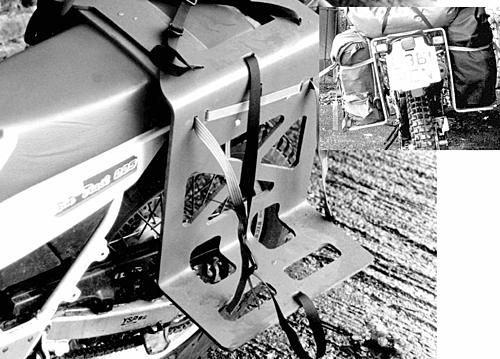
In case it helps to get ideas -or to find some defects to avoid- the rack on my XT the previous owner installed: very solid, but heavy as well. The 15y/o panniers are Swiss made, but look exactly the same as the TT (I read somewhere they were actually made in Switzerland). But these ones are hanging on the top bar and then pivot down to insert two screws through the holes on the solid bar crossing from one side of the rack to the other, and then screwed on the back with 2 nuts each. AKA, an absolute pain to mount and dismount (I am thinking on ways ideas to have an easier/safer system, but till now all imply welding...).
Three supporting points: footpegs, handle (?) and blinkers' holes. The panniers lay on a small bed, good to hold them but which to me looks like a blade if you fall at speed with no panniers on... 


Some painting in the balcony (artificial grass not yet ready to burn under arc welding!) 
Hope it helps 
|
25 Aug 2011
|
|
Registered Users
New on the HUBB
|
|
Join Date: May 2007
Posts: 13
|
|
 smashed bushes
why R the welded spacers stronger than the smashed bushes, OH i get it there us laterial movement on the saddle bag support
__________________

|
29 Aug 2012
|
 |
Super Moderator
Veteran HUBBer
|
|
Join Date: Jun 2000
Posts: 4,811
|
|
|
Pipe Rack
Some nice racks here; I've used a few pix to illustrate a couple of articles on my website.
I was looking to make a platform rack for my GS for the reasons I explain here, then it dawned on me that on one side at least, there's a ready made fixed platform: the silencer.
More details here.
Ch
Last edited by Chris Scott; 31 Dec 2013 at 14:45.
|
29 Aug 2012
|
|
Registered Users
Veteran HUBBer
|
|
Join Date: Apr 2008
Location: West Yorkshire UK
Posts: 1,785
|
|
|
Good idea but the engineer in me is worried. The single bolt from the V is a pivot point and probably includes a rubber bush. Load the silencer end and this makes a shear force where the pipe enters the silencer. Having destroyed a few silencers by rust and falling off, I'm pretty sure this is a weak spot (because the pipe was bent to shape) and when they go here they leak (because the pipe goes out of round). The vibration will probably cause a fatigue failure even if the actual load is low. I think your idea of adding a clamp round the far end of the silencer and running a bit of tube up towards the indicator is the solution, the pipe then is only loaded in compression and maybe a bit of tension.
If you get time, drill some holes in the channel, less heat conducted and less weight to load that pipe junction?
Andy
|
29 Aug 2012
|
|
Super Moderator
Veteran HUBBer
|
|
Join Date: Jun 2000
Posts: 4,811
|
|
Actually, it looks like a one-piece system (or push-in, maybe?) but I agree the pipe couldn't take much dead weight so yes, exhaust clamp is on the way to hook the end up to the subframe. As it is the silencer is rubber-mounted at the pillion footrest so there is some movement there.
The exhaust clamp also makes a convenient point to arrange the the back brace to the other side. Just found a good bit of galvanised flat bar to do that.
Will see how hot it all gets but I'd be surprised if the wood gets too warm plus the ally is only a couple of mm so I doubt much weight would be saved by drilling.
Ch
|
29 Aug 2012
|
|
Gold Member
Veteran HUBBer
|
|
Join Date: Jul 2008
Location: London
Posts: 404
|
|
|
Try copper
Quote:
Originally Posted by Alexlebrit

Any pictures of existing racks would be great too they seem quite hard to google up.
|
Now it's been thoroughly tested, I'll throw this rack into the mix.
Made from 15mm copper water pipe with Yorkshire fittings, it was constructed by the previous owner of my TTR.
Not being sure whether it was at all strong enough for trans-Africa, I thought - what the hell, it looks so elegant, I'll just go with it.
Do you really need heavy steel?
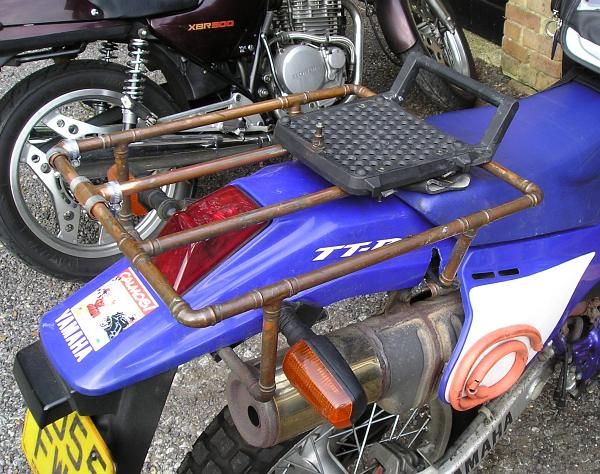
The rack as it came with the bike, moved forward so the front sits on the pillion seat.
Plus Nonfango base fitted.
The jubilee clips that maybe you can see, hold 22mm plain solder fittings (an elbow and a tee), sawn in half and clamped around two joints.
That was my attempt at a bit of strengthening. It looked a mess, so probably wasn't effective, so I removed them before departure.
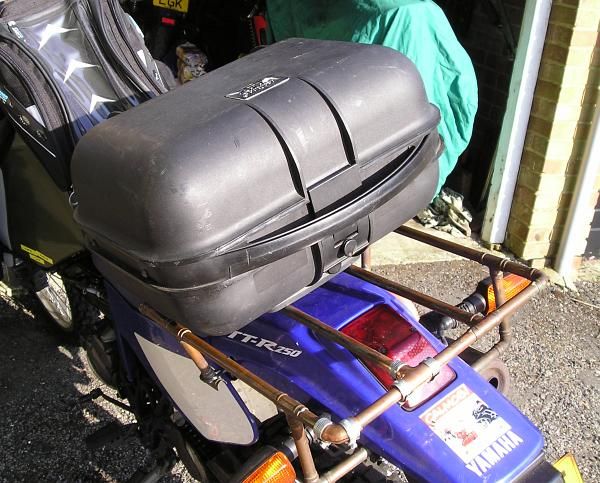
With second-hand box.
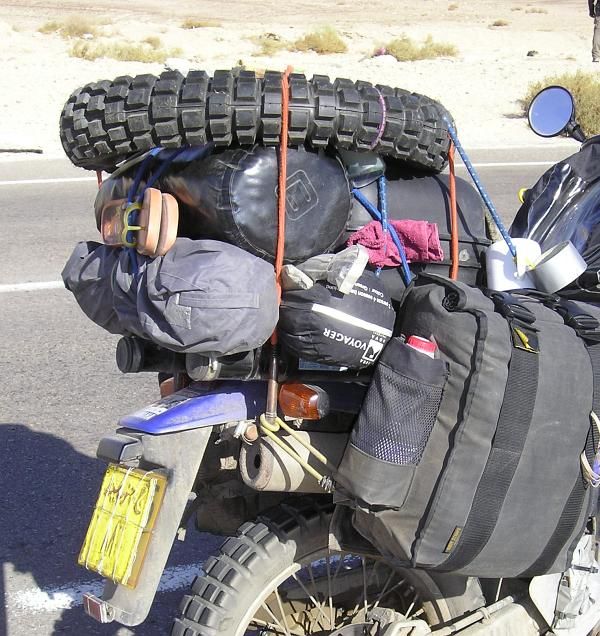
Rack loading, London to Khartoum (photo in Sinai). The Nonfango box is in there somewhere....
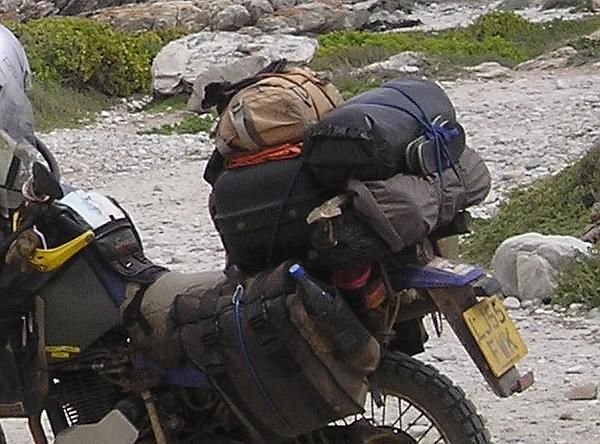
Rack loading, Khartoum to Cape Town (photo at Cape Agulhas)
20,000 miles in total, including a few hundred miles of dirt, sand and stones in each of N. Kenya, W. Tanzania, and Namibia. Plus bits elsewhere.
Plus the 40,000 tarmac miles the previous owner did, before I bought it.
It's still in use, carrying (slightly less) weight, and no signs of splits, cracks, breaks or anything else you can think of. A credit to the constructor. (ex-British Rail).
Do you really need heavy steel? I don't think so.
Quality of construction is key.
|
29 Aug 2012
|
|
Super Moderator
Veteran HUBBer
|
|
Join Date: Jun 2000
Posts: 4,811
|
|
Copper tube, I like it, but would it work on the side holding boxes and dealing with crashes, or even as a platform?
I was looking into doing a similar thing with thin steel EMT (electrical conduit) but it required threading the ends to make right-angle bends - another tool I'd use once. Were it possible, soldering (like copper joints) would have been easier.
Avoiding welding does stir up the creativity.
|
29 Aug 2012
|
|
Gold Member
Veteran HUBBer
|
|
Join Date: Jul 2008
Location: London
Posts: 404
|
|
|
Oops.... you just beat me to it Chris.
I don't want any flack for omitting this.....
It's right out of sight, so I always forget when singing the praises of this rack.
The pipework is filled with epoxy resin.
It makes all the difference. - Quality of construction.
I had a few offs, fully loaded, in Africa (generally on soft ground).
And more since returning home (green lanes).
But nothing serious - and I hope not to test it along such lines.
I continued the constructor's philosophy for attaching it to the bike, he used only zip ties.
If the rack gets hit, it moves and the zip ties give. (Or break).
When I moved it forward so a lot of the weight was placed on the pillion seat, I reduced the number of zip ties to the minimum that I thought was necessary.
When I inspected stuff on return home, I found just one had broken.
As far as holding anything on the side is concerned - I don't know.
But the entire weight of the Andy Strapz panniers is held by the rack, where it sits on the pillion seat.
So to say the least, I'm pretty pleased with the whole thing.
|
30 Aug 2012
|
 |
Registered Users
Veteran HUBBer
|
|
Join Date: Mar 2006
Location: West London
Posts: 920
|
|
I have a feeling I've seen the copper pipe rack at the Ace Café Adventure & Overland day, if it was yours I was very impressed. I didn't realise it was epoxy filled though, I wonder how much difference it makes.
Welding always seems to be the bugbear for DIY rack creation, and blokes who'll do a bit of welding for  money seem harder to come by these days so maybe copper is the answer? Still got to learn how to braze though.
__________________
Happiness has 125 cc
|
30 Aug 2012
|
|
Gold Member
Veteran HUBBer
|
|
Join Date: Jul 2008
Location: London
Posts: 404
|
|
Quote:
Originally Posted by Alexlebrit
I have a feeling I've seen the copper pipe rack at the Ace Café Adventure & Overland day, if it was yours I was very impressed. I didn't realise it was epoxy filled though, I wonder how much difference it makes.
Welding always seems to be the bugbear for DIY rack creation, and blokes who'll do a bit of welding for money seem harder to come by these days so maybe copper is the answer? Still got to learn how to braze though. |
Yes, I like an excuse to have lunch (or breakfast) at the Ace. I think it's a great bit of heritage.
And yes, I think the epoxy filling in the rack makes the whole thing practicable. I don't think it would work without it.
This isn't the only copper-pipe rack, I've seen another a few weeks ago, somewhere around London, but can't for the life of me remember where.
Can copper be brazed? I thought soldering or silver solder were the only options for joining it.
Or does silver solder come under the heading of brazing?
If you can solder with a flame and separate flux, silver-soldering isn't too difficult. But practicing can be expensive.....
|
30 Aug 2012
|
|
Super Moderator
Veteran HUBBer
|
|
Join Date: Jun 2000
Posts: 4,811
|
|
I thought the great thing with joining copper pipes is that the joints have solder built into a ring inside - as shown here. From the top picture of the TTR, it looks like those sort of joints were used.
With pre-soldered joints, all you do is link up and blowtorch it - the inner solder ring melts, cools and seals. Even i could do that although perhaps it's not as strong as hand soldered?
If an epoxy resin filling is the key to strength then I wonder if that makes aluminum tube an option and possibly cheaper too? Easy joints here or here (UK)
And copper or ally, could the epoxy double up as joint glue too?
|
30 Aug 2012
|
 |
Contributing Member
Veteran HUBBer
|
|
Join Date: Jan 2008
Location: England
Posts: 649
|
|
Quote:
Originally Posted by Chris Scott
And copper or ally, could the epoxy double up as joint glue too?
|
I have done a fair bit of stainless steel handrail / ballustrading that is joined with epoxy and that works very well but uses precisely engineered fittings that have a couple of o-rings to control the glue.
In my opinion, copper tube just isn't up to the job for a rack though; it's too soft and I'm pretty sure that size for size, it's heavier than steel. Easy to work though and might be a way of putting together a prototype.
I use good quality seamless steel tube, with end plates or buckets at fixing points. I don't like off the shelf racks with the tube crushed and drilled for fixings. Easy, cheap but a bit crappy IMHO.
Here's one to throw into the mix........strength for weight, you'd be hard pushed to better wood. Some nice spruce would make a very strong rack :-)
|
30 Aug 2012
|
|
Super Moderator
Veteran HUBBer
|
|
Join Date: Jun 2000
Posts: 4,811
|
|
Quote:
|
I have done a fair bit of stainless steel handrail...
|
In that case what is your opinion on these hex key joints, BYT?
Am I right in thinking they would need a fairly thick-wall tube not to deform under the screw and so you end up needing unnecessarily heavy tubing?
I think the key with copper is it's easy to join + the resin filling gives the strength as McC has shown. But it might get heavy on a full rack.
Quote:
|
I don't like off the shelf racks with the tube crushed and drilled for fixings. Easy, cheap but a bit crappy IMHO.
|
I agree. The last OTS bike rack I had had fittings like that. I was rather surprised. Acceptable if DIY but not when paying 220 quid +.
Talking of other materials reminds me of this one - a strap-on plastic platform rack, heated into shape.
|
31 Aug 2012
|
|
Registered Users
Veteran HUBBer
|
|
Join Date: Aug 2012
Location: Australia
Posts: 1,131
|
|
|
Soldering
Information
You can solder - * Steel
- * Stainless Steel
- * Copper
- * Brass
- * even Aluminium (but the solider is expensive and hard to come by)
If you cover or fill the inside of any solder item it will make any repair that much more difficult.
There are various types of solder, some cheap, some with better vibration strength. Best to go cheap as that will be more common in places where you may need a repair.
Failures on most things occur near the ends - you can strengthen the ends by putting another short length of tube side the first. You could solder it there too (to further increase the strength) provided you are not going to brazed or weld it.
Copper is heavier and more expensive than steel. For those reasons most people use steel. Copper can be tempered using heat (just like steel) to make it 'hard' (or stiff in non techinical terms).
The plumbing joints that include the solider will be as strong as those without, they are just more expensive (but reduces the labor cost so cheaper for people paying for labor, and you probable cannot get thoes without solider any maore anyway).
|
31 Aug 2012
|
|
Registered Users
Veteran HUBBer
|
|
Join Date: Mar 2006
Location: West London
Posts: 920
|
|
So, would it be possible to use self-soldering copper joints with mild steel tubing? Or would some strange reaction occur (like mixing steel and aluminium)? That might be the simplest solution for the incapable-of-welding.
The perk to copper pipe is that it's easily available, soft enough to bend without tools, cuts easily and there are ready made joints available. If nothing else that makes it very useful for prototyping, more useful than the plastic conduit I've used in the past as it can actually bear some weight which means you can test hang, and even ride with, panniers.
Then once we're happy it shouldn't be too hard to take the copper and get a steel version welded up.
Chris: your image of the throw-over plastic rack...
...takes me right back to my square one and thoughts on semi-rigid panniers. Unfortunately I'm one of those people who can see something in their head, but really struggle to translate that into a sketch. I could make one, but draw it? Do you have any more info on it? Type of plastic used etc.?
__________________
Happiness has 125 cc
|
|
Currently Active Users Viewing This Thread: 2 (0 Registered Users and/or Members and 2 guests)
|
|
|
 Posting Rules
|
You may not post new threads
You may not post replies
You may not post attachments
You may not edit your posts
HTML code is Off
|
|
|
 Similar Threads
|
| Thread |
Thread Starter |
Forum |
Replies |
Last Post |
|
Luggage Rack
|
BuzzBum |
Yamaha Tech |
3 |
3 Oct 2008 23:58 |
|
H&B Luggage Rack
|
IanW |
KTM Tech |
1 |
8 Nov 2003 17:43 |
|
Luggage Rack XR 600
|
XR Max 600 |
Equipping the Bike - what's the best gear? |
2 |
20 Feb 2003 22:49 |
|
luggage rack
|
Kurt Ellul |
Honda Tech |
1 |
22 Jan 2003 03:15 |
|
luggage rack
|
Kurt Ellul |
Equipping the Bike - what's the best gear? |
1 |
21 Jan 2003 23:44 |
|

Check the RAW segments; Grant, your HU host is on every month!
Episodes below to listen to while you, err, pretend to do something or other...
2020 Edition of Chris Scott's Adventure Motorcycling Handbook.
"Ultimate global guide for red-blooded bikers planning overseas exploration. Covers choice & preparation of best bike, shipping overseas, baggage design, riding techniques, travel health, visas, documentation, safety and useful addresses." Recommended. (Grant)

Ripcord Rescue Travel Insurance™ combines into a single integrated program the best evacuation and rescue with the premier travel insurance coverages designed for adventurers.
Led by special operations veterans, Stanford Medicine affiliated physicians, paramedics and other travel experts, Ripcord is perfect for adventure seekers, climbers, skiers, sports enthusiasts, hunters, international travelers, humanitarian efforts, expeditions and more.
Ripcord travel protection is now available for ALL nationalities, and travel is covered on motorcycles of all sizes!
What others say about HU...
"This site is the BIBLE for international bike travelers." Greg, Australia
"Thank you! The web site, The travels, The insight, The inspiration, Everything, just thanks." Colin, UK
"My friend and I are planning a trip from Singapore to England... We found (the HU) site invaluable as an aid to planning and have based a lot of our purchases (bikes, riding gear, etc.) on what we have learned from this site." Phil, Australia
"I for one always had an adventurous spirit, but you and Susan lit the fire for my trip and I'll be forever grateful for what you two do to inspire others to just do it." Brent, USA
"Your website is a mecca of valuable information and the (video) series is informative, entertaining, and inspiring!" Jennifer, Canada
"Your worldwide organisation and events are the Go To places to for all serious touring and aspiring touring bikers." Trevor, South Africa
"This is the answer to all my questions." Haydn, Australia
"Keep going the excellent work you are doing for Horizons Unlimited - I love it!" Thomas, Germany
Lots more comments here!

Diaries of a compulsive traveller
by Graham Field
Book, eBook, Audiobook
"A compelling, honest, inspiring and entertaining writing style with a built-in feel-good factor" Get them NOW from the authors' website and Amazon.com, Amazon.ca, Amazon.co.uk.
Back Road Map Books and Backroad GPS Maps for all of Canada - a must have!
New to Horizons Unlimited?
New to motorcycle travelling? New to the HU site? Confused? Too many options? It's really very simple - just 4 easy steps!
Horizons Unlimited was founded in 1997 by Grant and Susan Johnson following their journey around the world on a BMW R80G/S.
 Read more about Grant & Susan's story
Membership - help keep us going!
Horizons Unlimited is not a big multi-national company, just two people who love motorcycle travel and have grown what started as a hobby in 1997 into a full time job (usually 8-10 hours per day and 7 days a week) and a labour of love. To keep it going and a roof over our heads, we run events all over the world with the help of volunteers; we sell inspirational and informative DVDs; we have a few selected advertisers; and we make a small amount from memberships.
You don't have to be a Member to come to an HU meeting, access the website, or ask questions on the HUBB. What you get for your membership contribution is our sincere gratitude, good karma and knowing that you're helping to keep the motorcycle travel dream alive. Contributing Members and Gold Members do get additional features on the HUBB. Here's a list of all the Member benefits on the HUBB.
|
|
|











 smashed bushes

 Linear Mode


