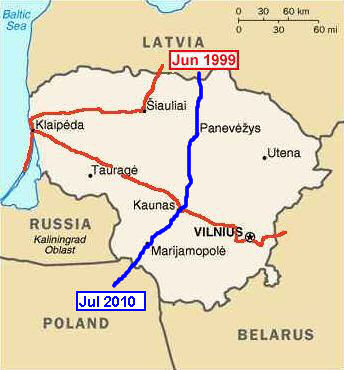
This is part of the fifth section of our around
the world trip.
Complete Trip Overview &
Map
Coming from Latvia
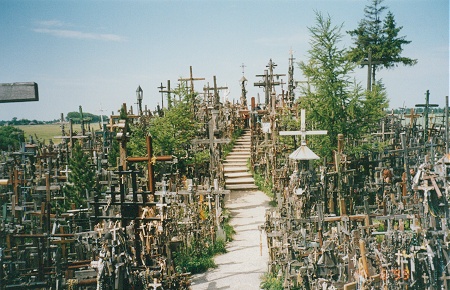
19/6/99 Latvia to Lithuania and another easy border crossing. Siauliai, just over the border, has two hillocks, out of town, where since the 14th century people have come to plant crosses. The hillock planting became very popular during Soviet times when people disappeared without trace, the crosses being the only way to remember the loved one. Not liking either the concept or religion the hillocks were bulldozed three times by the Soviets only to reappear. Today there is almost no room to plant another cross and visitors buy, by the thousands, small crosses to hang on larger ones already planted. This concept seems a great way to bury "missing" dead relatives or friends, a non denominational, non sectarian, non government place for people to remember.
20/6/99 We had stayed last night at Neringa, on a 90
km long sandy spit, rising out of Kaliningrad. The five minute ferry
ride then
drive down the pine and scrub covered sand dune spit to Preila. Some
dunes
are over 60 meters high and the scenery and local fish draw German
tourists
in summer giving the locals economy and prices a boost. With
Lithuania's coast
only 100 km long there is great demand on the sandy beaches.
21/6/99 Early summer weather is unusually hot this year and bringing with it late afternoon electric/thunder storms similar to the wet season in Northern Australia. After riding to Trakai this morning and visiting the Gothic restored red brick castle situated on an island in the beautiful lake we were dumped on by a violent afternoon storm.
22/6/99 Vilnius, the third of the Baltic capitals,
equally as busy rebuilding, renovating and restoring as the other two,
trying to find
their past and future. All the churches are being repainted including
the
St Kazimieras church which for over 20 years was used as a museum of
atheism
during the Soviet era. Despite the modernization and new wealth the
horrors
of the past can be viewed at the genocide museum. We were guided by a
former
inmate of the KGB building where underground are numerous processing
cells.
Used before the war by the USSR, during the war by the Germans and
again
by the USSR until the last prisoner was processed for release in 1991. The 15
minutes a day exercise, once a day toilet visit and once a month shower
all documented in the archives not destroyed during the Soviet
withdrawal.
The 15
minutes a day exercise, once a day toilet visit and once a month shower
all documented in the archives not destroyed during the Soviet
withdrawal.
Move with us to Belarus
or go to our next visit to Lithuania
|
Story and photos copyright Peter and Kay Forwood, 1996-
|