




Highest motorable pass in the world: Marsimek-La, 18,634 feet
Satellite image of Marsimik - La
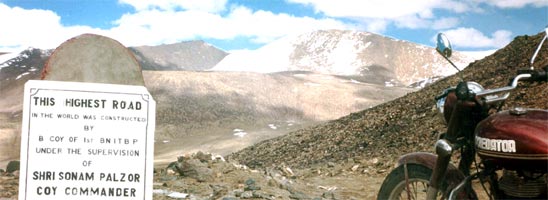
Hundreds of bikers ride to Leh every year and subsequently to Khardung-La, 52 kms from Leh. Khardung-La, at an altitude of 18,380 feet is also known as the highest motorable pass in the world.
But recently, a little know pass in Changthang has bikers searching for more information. To the north-east of Khardung-La and below the Karakoram range lies Marsimek-La / Marsimik-La / Marsimik-La.
Few facts about Marsimek-La:
- The name of the pass is spelled as Marsimik-La and not Marsimik-La nor Marsmik-La (referring to several articles on the Internet).
- Why is Khardung-La at 18,380 feet still called the highest motorable pass when Marsimek-La stands at an altitude of 18,634 feet?
Firstly, while the Khardung-La pass above the road probably stands at 18,380 feet, the road below the pass stands at around 17,580 feet. All roads leading to the Indian Borders are made by BRO (Border Roads Organization), an Army outfit. Although the real reason behind the inflation to make a record breaking pass might never be known, but I can safely assume that Marsimek-La is not hyped because firstly it is built by the ITBP (Indo Tibetan Border Police) and not the BRO.
Secondly, the Army authorities probably think it best not to advertise the pass and invite civilian traffic to the border area. The track to Marsimek-La leads to the border posts and is used to ferry food and other supplies there.

Route:
Marsimek-La is on the northern-most tip of the Changthang Plateau. Take the road from Leh towards Pangong-Tso via the Chang-La pass. Just meters before Pangong-Tso, a dirt track breaks to the left. The track is so small that if your not alert, you will miss it. This track will take you to Marsimek-La. The pass is still 32 kms away from this turn.
Ten kms on and riding over two not-so-high passes, you will reach Phobrang. The rough and loose track en route is a sign of what lies between you and Marsimek-La after Phobrang.
There is an ITBP Post at Phobrang. The chaps are always welcoming and offer all possible assistance; but fail to understand why someone would want to ride up to to the pass where even their 4x4 vehicles struggle.
The Phobrang ITBP camp is the place where one should remove all the luggage from the bike, except for the tool kit. The bike needs to be lighter so it can negotiate the stiff incline before the pass.
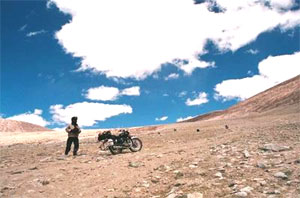
Marsimek-La is now lies 22 kms ahead. The track climbs up from Phobrang instantly.
The first 18 kms is a dirt track crossing several mountains. No valley on either side of the track - it's just riding in middle of a mountain. It is all sand and gravel and the track is inclined to your left. To add to that, there is lots of loose dirt which makes the bike go haywire. But nothing that would really pose a threat to the bike or the biker.
There are no passes or sub passes for these 18 kms, the road relatively straight, barring few loops and hairpin bends.
Just when one is captivated by the vast and empty landscape, a steep sandy climb breaks the trance and you will know it's time to rock and roll. The stretch from here on is an arrogant incline full of sand and boulders. From here on no matter what bike you have, 350cc, 500cc, RD350 or 750cc interceptor, it will stall. The bike cannot climb through the sand, just not possible since it bogs down into it. The loose sand on and before the incline is a result of the heavy Army vehicles spinning their knobbly tires before the climb.
The trick is to bring the bike in good speed with as much momentum and climb as far as you can. Once it stalls (it is bound to), get down and start pushing the bike :-) Take a break, restart the bike and push it again.
But at 18,000 feet, there is hardly any oxygen for the bike and the rider. Few meters of pushing and you have to halt for a breather and the moment you stop for a break, the bike sinks more into the sand! Pulling it out of course needs extra effort.
Taking 10 steps up that incline at 17,000+ feet is an ordeal. It's a combination of you and your bike not getting enough oxygen under extremely testing conditions which takes the maximum toll. The road conditions are next to impossible to be driven through even with the maximum oxygen available, least of all at that altitude. Low oxygen for your own lungs, also means lesser energy in you to handle or push the bike.
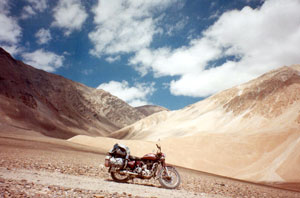
The last 3-3.5 kms before the pass is not a fair battle between bike and mountain. From here onwards you take the bike, I mean push it, rather than ride it to the top. It's more of physical strength than riding skill, also the mental toughness. And most importantly - the adamant attitude to reach the top, no matter what. Here Marsimek-La will test every rider and bike.
The incline is just 70 mts, but to cross that, you will pant like a dog. You'll feel like ripping all your clothes just for a breath of air, your head spinning with dizziness.
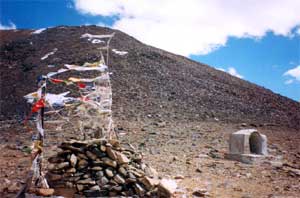
Once this incline is crossed, a slightly inclined plateau lies ahead, housing many abandoned army huts. Another set of hairpin bends, few inclines and you will be welcomed by a sight of prayer flags, welcoming you to Marsimek-La.
The ecstasy after the agony to reach the pass cannot be described in words, but on sight of the milestone, all the fatigue goes away.
It proudly reads -
CHAK DE
MAPSIMEK - LA
WORLD'S HIGHEST MOTORABLE PASS
AT ALT - 5590 MTS - 18,634 FEET
CONST BY 6FD COY
236 C/R CHAK DE
CHAK DE
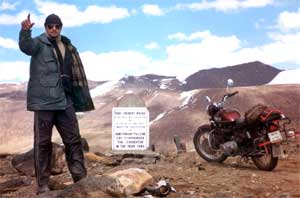
Marsimek-La is misspelled on the milestone, with a "P" in place of "R". The track to Marsimek-La was built in 1983 under the supervision of Sonam Paljore, an Everester. There is also a small temple called "Chak Mandir" which has a picture of Lord Shiva.
Marsimek-La does give the rider a tough fight; there is no way one can use his/her riding skills to get up there. It's not about adroit riding but about the mental strength of rider, a single-minded ambition to see the incline through.
Tips for Marsimek-La:
- Marsimek-La is an inner line route. You will need to obtain permission from Leh District Authorities to go there.
- Keep all your luggage at the Phobrang ITBP camp. Just carry your tool-kit and spare bag, which you might want to leave on the incline 3.5 kms before the pass.
- Tune the carburettor to supply more air to the engine, make the mixture lean. Removing the air filter also might help.
- Start the ride for M-top at 8 a.m. from Phobrang. Before 8 it will be very cold and after that high velocity winds start. You will should be at M-top by 10-10.30 a.m.
- Also read the travelogue to Marsimek-La here We have titled it Marsimik-la on the page so that the result shows up on search engines. So much for Trailblazing ;-)
HAPPY TRAILS,
Gaurav & Praveen
If you wish to add more tips which are not mentioned above, kindly e-mail them at ther...@60kph.com. We will gladly add them to the list.

Global Rescue is the premier provider of medical, security and evacuation services worldwide and is the only company that will come to you, wherever you are, and evacuate you to your home hospital of choice.
Additionally, Global Rescue places no restrictions on country of citizenship - all nationalities are eligible to sign-up! Travel medical insurance is also available, currently the limit is 90 days. (TIP: For Evac insurance - Click Multiple Trips and 365 days to get year long insurance.)
Ripcord Rescue Travel Insurance™ combines into a single integrated program the best evacuation and rescue with the premier travel insurance coverages designed for adventurers.
Led by special operations veterans, Stanford Medicine affiliated physicians, paramedics and other travel experts, Ripcord is perfect for adventure seekers, climbers, skiers, sports enthusiasts, hunters, international travelers, humanitarian efforts, expeditions and more.
Ripcord travel protection is now available for ALL nationalities, and travel is covered on motorcycles of all sizes! NOTE: Travel medical insurance currently has a limit of 90 days.
Member login
Announcements
Thinking about traveling? Not sure about the whole thing? Watch the HU Achievable Dream Video Trailers and then get ALL the information you need to get inspired and learn how to travel anywhere in the world!
Have YOU ever wondered who has ridden around the world? We did too - and now here's the list of Circumnavigators!
Check it out now, and add your information if we didn't find you.
Are you an Overland Adventure Traveller?
Does the smell of spices wafting through the air make you think of Zanzibar, a cacophony of honking horns is Cairo, or a swirl of brilliantly patterned clothing Guatemala? Then this is the site for you!
Hosted by Grant and Susan Johnson, RTW 1987-1998
Next HU Events

HU Event and other updates on the HUBB Forum "Traveller's Advisories" thread.
ALL Dates subject to change.
2024:
- California: April 18-21
- Virginia: April 25-28
- Germany Summer: May 9-12
- Québec: May 17-19
- Bulgaria Mini: July 5-7
- CanWest: July 11-14
- Switzerland: August 15-18
- Romania: August 30-Sept 1
- Ecuador: August 24-25
- Austria: September 12-15
- France: September 20-22
- Queensland is back! Oct 4-7
- Germany Autumn: Oct 31-Nov.3
- South Africa: November
Add yourself to the Updates List for each event!
Questions about an event? Ask here
HU Achievable Dream is Online
and available now to stream on Vimeo!
ALL 15 chapters of the HU Achievable Dream Guide are available to download on Vimeo!

Binge watch over 18 hours of inspiring, informative and entertaining stories and tips from 150 travellers!
"a cross between entertaining stories, tech tips, and reference guide"
"A timeless introduction to Motorcycle Adventure Travel!"
Originally launched as a 7 DVD set, The Achievable Dream series can now be downloaded anywhere. OVER 18 hours of solid info take up zero space in your panniers. How convenient!
Books

All the best travel books and videos listed and often reviewed on HU's famous Books page. Check it out and get great travel books from all over the world.
NOTE: As an Amazon Affiliate we earn from qualifying purchases - thanks for your help supporting HU when you start from an HU Amazon link!